


Copys or Copies? Copies are the correct spelling. Copy ends in a consonant plus y, so you drop the y and add ies. That’s the whole rule. Copys is just a typo. It looks close, but it’s wrong. Even native speakers make this slip. Fast typing and habit cause most of these errors, so don’t feel bad. Spell checkers flag it, but they don’t explain why. Don’t worry, it happens to everyone.
Copys or Copies is a small choice with a big impact. One wrong letter can make your email look sloppy. Toy works differently. A vowel comes before the y, so you just add s. That’s why toys are correct. Here, you’ll learn the rules, the exceptions, and real examples. A simple memory trick will help too. It only takes two minutes. Copys or Copies won’t confuse you again.
Copys or Copies — Quick Answer
Picture this. You’re typing “Please send me three copys of the report” and something feels off.
Your spell checker draws a red line, and you wonder if it’s just being picky.
It isn’t. The correct spelling is copies.
No major dictionary accepts copys, including Merriam-Webster and the Cambridge Dictionary.
Short version: more than one copy means copies.
That’s the correct plural in English spelling.
| Form | Status | Example |
| copy | Correct singular | I need one copy of this form. |
| copies | Correct plural | I need five copies of this form. |
| copys | Incorrect spelling | I need five copys of this form. |
Why This Confusion Happens
Most people learn early that you make a plural form by adding s.
Cats, dogs, books, pens. It works so often that the brain runs on autopilot.
Then along comes a word like copy, and autopilot fails.
The result is spelling confusion, and it hits native speakers as often as English learners.
The Real Reason People Get It Wrong
We type fast, and we trust habits over rules.
Adding s feels natural, so copys slips out before we stop to think.
Key Insight
The problem isn’t that you’re a bad speller.
It’s that one spelling rule has a twist, and nobody points it out until it bites you.
The Rule: How to Form Plurals of Words Ending in “Y”
English gives you two paths for words ending in y.
Which path you take depends on the letter sitting right before the y.
Once you spot that letter, the choice takes about a second.
Let’s break it down, and you can also check the Cambridge grammar page on plural nouns if you want a second opinion.
Read More: Doughnut vs Donut: Which Spelling Is Actually Correct? 2026
Core Rule
If a consonant comes before the y, change the y to i and add es.
That’s the Y → IES rule, also written as change y to ies.
Examples
Cities become cities, and babies become babies.
Party becomes parties, story becomes stories, and family becomes families.
Why This Rule Exists
Old English spelling habits shaped it, and it stuck around.
A y after a consonant behaves like an i sound, so ies reads smoothly and matches the spelling patterns we already use.
Step-by-Step Breakdown: Copy → Copies

Let’s walk through it slowly, like a friend explaining it over coffee.
The word is copy → copies, and every step is small.
Transformation Process
First, look at the letter before y.
In copy that letter is p, and p is a consonant, so this is consonant + y = ies.
Next, remove y, then add ies, and you land on copies.
Simple Rule to Remember
Drop the y, add ies whenever a consonant comes before it.
Say it out loud twice and it’ll feel automatic.
When You Do NOT Change “Y” to “IES”
Now for the twist that catches people out.
Some words ending in y just take a plain s, and that’s the exception rule.
Skip this and you’ll start writing “boies” or “dayies” by mistake.
Overcorrecting is just as common as forgetting the rule.
Exception Rule
If a vowel comes before the y, keep the y and add s.
Short version: vowel + y = s.
Examples
Toy becomes toys, key becomes keys, and boy becomes boys.
Day becomes days, and the vowels o, e, and a make that easy to see.
Why This Exception Exists
A vowel before y already carries the sound.
Changing the y to i would leave a clumsy pile of vowels, like “toies,” which looks strange and reads worse.
Comparing Both Rules Side by Side
| Letter before y | What you do | Example |
| Consonant | Drop y, add ies | copy → copies |
| Consonant | Drop y, add ies | city → cities |
| Vowel | Keep y, add s | key → keys |
| Vowel | Keep y, add s | day → days |
Why “Copies” Is the Only Correct Form
Dictionaries, style guides, and editors all agree here.
There’s no regional twist, no British versus American split, and no casual exception.
That’s good news, because you can stop second guessing.
Copies is the correct form everywhere, from a school essay to a legal contract.
Word Breakdown
Copy has a p before the y, and p is a consonant.
So the word follows the Y → IES rule without any drama.
Result
The correct plural is copies.
That’s the spelling you’ll find in every dictionary you open.
Important Note
Answers to “is copys a word” sometimes say it appears online, and that’s true.
But appearing in a text isn’t the same as being correct, since typos travel fast.
Why “Copys” Is Always Wrong
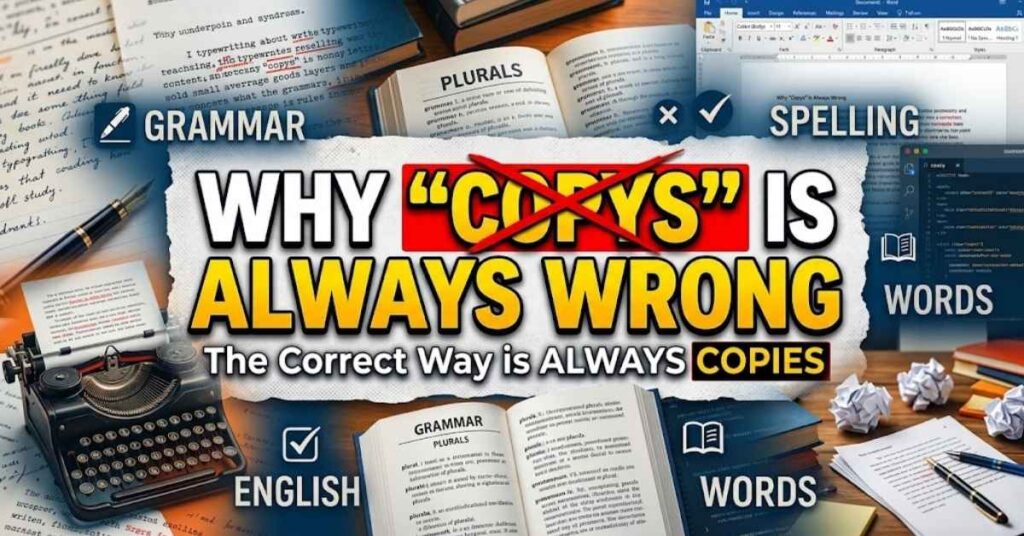
Here’s the blunt truth: copys breaks the rule for consonant + y words.
It also looks unfinished, like a word that stopped halfway.
People who ask “why is copys wrong” usually want a reason, not a scolding.
The reason is simply that English spelling has a pattern, and this word doesn’t follow it.
Problems with “Copys”
It ignores the plural rule, so it fails a basic spelling rule test.
It also gets flagged by every proofreading tool, so it can’t pass as a harmless variant.
Example
Wrong: “The clerk made ten copys of each file.”
Right: “The clerk made ten copies of each file.”
Real Impact
A single typo won’t sink your career.
Still, readers notice, and small writing errors chip away at credibility faster than you’d think.
Understanding “Copy” as a Noun
Most of the time, copy works as a noun.
It names a thing you can hold, share, or click.
Definition
As a noun, copy means a duplicate or reproduction of an original.
It can also mean one single issue of a book, magazine, or newspaper.
Common Uses
You’ll see it in offices, schools, and online.
Think printed pages, book editions, saved files, and advertising text, which writers call “ad copy.”
Examples
“Can I get a copy of that email?”
“She bought the last copy of the novel.”
Understanding “Copy” as a Verb
Copy also works as a verb.
That’s where a lot of the mix ups begin.
Definition
As a verb, copy means to make a duplicate or to imitate something.
You can copy a file, copy a recipe, or copy someone’s dance moves.
Examples
“I’ll copy the files to your drive.”
“He copies his dad’s laugh perfectly.”
Copies as a Verb Too
Here’s a fresh detail most guides skip.
Copies isn’t only a plural noun. It’s also the third person singular verb form.
So “She copies the notes” is correct, and it follows the same Y → IES rule.
Don’t mistake it for a plural just because it ends in ies, since the job it does in the sentence is different.
Copy vs Copies in Sentences
Seeing both words in action beats memorizing rules.
Let’s try the noun and verb versions, so you can hear how each one sounds.
As a Noun
“I kept one copy for myself.”
“The office made twelve copies before the meeting.”
As a Verb
“Please copy me on that message.”
“She copies every note into her planner.”
Common Plural Mistakes Similar to “Copys”
Copys has plenty of company.
These are common plural mistakes you’ll spot in emails, social posts, and even menus.
Examples
Citys instead of cities, and babys instead of babies.
Partys instead of parties, storys instead of stories, and familys instead of families.
Pattern Recognition
Each mistake has the same cause: a consonant before y and a lazy s tacked on.
Train your eye on that one pattern recognition habit, and most of these errors vanish.
Expanding Your Vocabulary: More “Y → IES” Words
The more examples you see, the faster the rule sticks.
Here’s a handy set of everyday nouns that follow it.
Common Words
Countries become countries, ladies become ladies, and the army becomes armies.
Puppy becomes puppies, and story, city, and party keep the streak going.
Practice Table
| Singular | Plural | Rule used |
| Lady | Ladies | Consonant + y |
| Army | Armies | Consonant + y |
| Puppy | Puppies | Consonant + y |
| Boy | Boys | Vowel + y |
| Toy | Toys | Vowel + y |
Real-Life Examples of “Copies” in Use
Rules feel dry until you see them in daily life.
So here are three places where copies show up all the time.
Office Environment
“Please print six copies of the agenda.”
That line appears in nearly every workplace, so getting it right matters for professional writing.
School Setting
“The teacher handed out copies of the worksheet.”
Students see the word constantly, which makes it a great place to build good habits.
Digital Use
“Make backup copies of your photos.”
It’s everyday usage in the cloud age, and typos here look careless in a tech guide or a help doc.
Read More: Grately vs Greatly: The Truth Behind This Mistake 2026
Case Study: Fixing a Common Writing Error
Let’s look at a small, realistic story.
It shows how a tiny slip changes how people read you.
Situation
Maya, a junior coordinator, sent a client a proposal email.
She wrote, “I’ve attached three copys of the contract for review.”
Problem
The client replied politely but pointed out the typo.
Maya felt embarrassed, since the rest of the email was solid.
Correct Version
“I’ve attached three copies of the contract for review.”
One small change, and the sentence reads clean.
Result
Maya started proofreading before every send.
Her next emails went out without a single red line, and clients stopped mentioning typos.
Key Lesson
Attention to detail builds trust.
A quick check of plural endings takes seconds and protects your reputation.
Common Pitfalls When Writing Plurals
Even people who know the rules slip sometimes.
Speed, distraction, and overthinking are the usual culprits.
Frequent Issues
Adding s to a consonant + y word is the classic slip.
The reverse happens too, when writers turn a vowel + y word into ies.
Examples
Wrong: “keies” and “boies.”
Right: “keys” and “boys,” since a vowel sits before the y.
Copy’s, Copies’, and the Apostrophe Trap
Another fresh angle worth covering is the apostrophe.
Plurals never need one, so “I made two copy’s” is wrong.
An apostrophe shows possession instead.
“The copy’s edges were torn” is fine, and “the copies’ covers were torn” works for several copies.
Tips to Avoid This Mistake
Knowing the rule is one thing, and using it under pressure is another.
A few simple habits close that gap.
Practical Strategies
Here are steps you can start using today.
Each one takes only a few seconds.
- Check the letter before y every time you pluralize.
- Read it aloud, since “copies” sounds different from “copys” in your head.
- Run a proofreading pass for plural endings before sending.
- Use grammar tools as a safety net, but don’t rely on them alone.
- Keep a short list of your own repeat mistakes.
Memory Trick That Actually Works
Rules stick better when they come with a picture.
So let’s build a tiny mental hook that you can carry anywhere.
Trick
Think of the consonant as a bodyguard who won’t let me stay.
The y gets swapped out for ies, and the bodyguard stays put.
Example
P is the bodyguard in the copy.
So y leaves, ies arrives, and you get copies.
One-Line Rule
Consonant before y? Drop the y, add ies.
Vowel before y? Just add s.
When “Copy” Does NOT Change
Not every sentence needs a plural.
Sometimes the copy stays exactly as it is.
Read More: Speach or Speech: Which Spelling Is Correct? 2026
Singular Usage
Use the singular form when you mean one item.
“I need a copy of the receipt” is perfect as written.
Key Point
Count first, then spell.
One item gets copied, and more than one gets copies.
Why Correct Spelling Matters More Than You Think
Spelling might feel like a small thing.
Yet readers use it as a quick shortcut to judge how careful you are.
Good spelling supports readability, writing clarity, and clear communication.
It also helps professional communication feel polished, whether you’re writing a résumé or a blog post.
Benefits of Correct Spelling
You look reliable, and your message lands faster.
Readers stop noticing the mistakes and start noticing your ideas.
Real-World Impact
Hiring managers, clients, and teachers all skim for errors.
One clean page can tip a close decision in your favor.
Quote
Clean spelling won’t make a weak idea strong, but sloppy spelling can make a strong idea look weak.
Conclusion
Copys or Copies is now an easy choice. Copies are always the right spelling. Copy ends in a consonant plus y. So you drop the y and add ies. That rule works for the city, baby, and the party too. A vowel before the y changes things. Then you just add s, like toys and keys. Keep this pattern in mind. It saves you from silly typos. When you doubt yourself, check the letter before y.
Copys or Copies will not trip you up again. Copys is a typo, and now you know why. Read your work out loud before you hit send. Small checks make your writing look sharp. Did this guide help with Copys or Copies? Share it with a friend who still writes copys. Drop your questions in the comments. Remember, Copys or Copies has one answer. It’s copies.
FAQs
Q1:What is the correct form: “copys” or “copies”?
Copies are the correct form.
Copys isn’t accepted in standard English, so treat it as a typo.
Q2:Why do people make this mistake?
Most people learn to add s for plurals and apply it everywhere.
Fast typing and spelling confusion do the rest.
Q3:What is the rule for words ending in “y”?
After a consonant, drop the y and add ies.
After a vowel, keep the y and add s.
Q4:Are there other words like this?
Yes, plenty.
City, baby, party, story, family, country, lady, army, and puppy all follow the same pattern.
How can I avoid this mistake?
Check the letter before y each time.
Read your text aloud, proofread plurals, and use the one-line rule from this guide.

Oliver Matthew Wilson is a passionate grammar writer who shares simple English lessons, vocabulary tips, writing advice, and clear guides to help readers communicate confidently.