

Diddo or Ditto? Only one is right. The correct spelling is ditto. Diddo is a common mistake. It happens because we say the word fast. The “t” sounds soft, almost like a “d”. So people type what they hear.
Ditto means “the same” or “I agree.” You use it in lists, chats, and notes. Say a friend texts, “I love this song.” You reply, “Ditto.” Simple and friendly. It comes from the Italian word “detto,” which means “said.” That’s why it has two t’s. Still confused about Diddo or Ditto? Don’t worry. This guide makes it easy. You’ll learn the meaning, the origin, and simple examples. You’ll also see where each spelling goes wrong. By the end, the Diddo or Ditto question will be gone for good. Keep reading, and you’ll spell it right every time, even when typing fast.
What Does “Ditto” Mean?
Common Meanings:
Ditto is a tiny word with a few jobs.
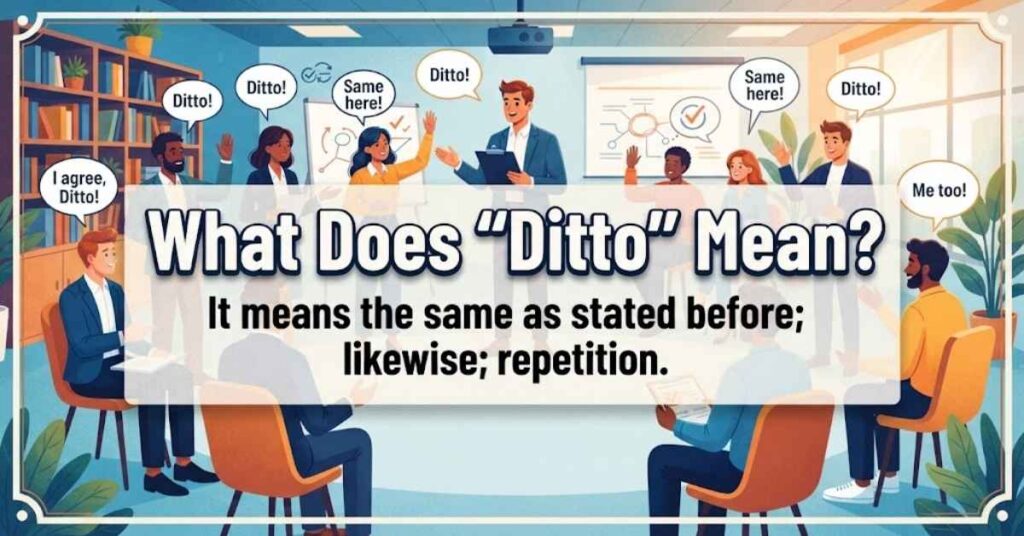
The dictionary entry defines it as “the same” or “the same as stated before.”
Here are the common meanings you’ll run into:
• Same as above: used in lists to repeat the previous item without writing it again.
• I agree: a quick reply that means “me too.”
• Likewise: what you say when someone shares a feeling and you feel it too.
Examples:
Say your friend texts, “I’m starving.”
You reply, “Ditto.”
That’s Ditto in a sentence at its simplest.
Here’s another one: “The meeting starts at nine, and ditto for the review call.”
Key Insight:
Ditto always points backward.
It only works when something previously mentioned gives it meaning.
So the meaning of Ditto depends on context.
Without an earlier line to copy, the word has nothing to hold on to.
The Origin of Ditto
Historical Usage:
The word has an Italian origin.
It comes from “detto,” meaning “said,” which traces back to the Latin “dictus.”
English borrowed it in the 1600s from merchants and bookkeepers.
They used it in accounting and lists so they didn’t write the same entry twice.
You can check the historical root in the Merriam-Webster entry and the Online Etymology Dictionary.
Read More: Surprise or Suprise? The Spelling Trick Everyone Misses 2026
Why This Matters:
Knowing the origin of Ditto explains the spelling.
The double “t” comes straight from “detto,” which has a double “t” too.
Nothing in that linguistic basis points to a “d” in the middle.
That’s why “diddo” doesn’t hold up.
Why Do People Write “Diddo”?
Common Reasons:
The biggest reason is pronunciation.
In American speech, a “t” between two vowels softens into a quick “d” sound.
So “ditto” sounds like “diddo” when you say it fast.
People who rely on pronunciation write what they hear.
A few other triggers make this spelling confusion worse:
• Typing quickly and skipping a second look.
• Autocorrect limitations that let a typo slide through in a rushed message.
• Lack of awareness that the word came from Italian.
• Seeing the error on social media and online comments, then copying it.
British vs American English
Important Fact:
Here’s the good news.
There’s no regional variation for this word.
British English and American English both spell it “ditto.”
The plural is “dittos,” and the verb forms are “dittoed” and “dittoing.”
Key Takeaway:
Pronunciation may differ a little.
British speakers often keep a crisper “t,” while Americans soften it.
The standard spelling stays the same everywhere.
In standard English, “diddo” never shows up as a variant.
When Should You Use “Ditto”?
Use Ditto In:
Lists
Lists are where Ditto started, and it still shines there.
It tells readers to repeat the previous item exactly.
In old ledgers you’d spot a small mark under an entry.
That tick, called a ditto mark, meant “same as above.”
Conversations
In casual chat, ditto works as a warm, fast reply.
Someone says, “Love this song,” and you answer, “Ditto.”
It keeps the spoken language feel of the exchange.
It’s friendly and a little playful.
Notes and Records
In notes and records, ditto helps you stay concise.
It trims repeated words in logs, inventories, and quick meeting notes.
Use it only when the line above is clearly visible.
Otherwise your reader may lose track of what “same” refers to.
Avoid Ditto In:
Skip it in formal writing like legal documents, academic papers, and reports.
Those need full wording so nothing gets misread.
• Contracts and other legal documents.
• Any academic paper or thesis.
• Formal client emails.
• Technical writing where precision matters.
Ditto also sounds too casual for professional communication with people you don’t know well.
When in doubt, spell out the full phrase.
Common Mistakes with Diddo or Ditto
Using “Diddo” Instead of “Ditto”
This is the big one.
Diddo isn’t a recognized word in standard dictionaries, so it counts as an incorrect form.
Readers notice it fast.
A tiny spelling error like this can dent your professional perception.
Overusing “Ditto”
Some writers sprinkle ditto into every other line.
That gets old quickly.
Use it where it saves space or adds warmth.
If you want to avoid repetition, vary your wording too.
Using It in Formal Contexts
A client email that says “Ditto on the budget” feels off.
The tone is too relaxed for a formal context.
Pick “the same applies” or “I agree” instead.
Those keep things polished.
Misunderstanding Meaning
Some people think ditto means “thanks” or “okay.”
It doesn’t.
It only means “same” or “I agree.”
Using it for anything else leaves readers puzzled.
Diddo or Ditto in Everyday Examples
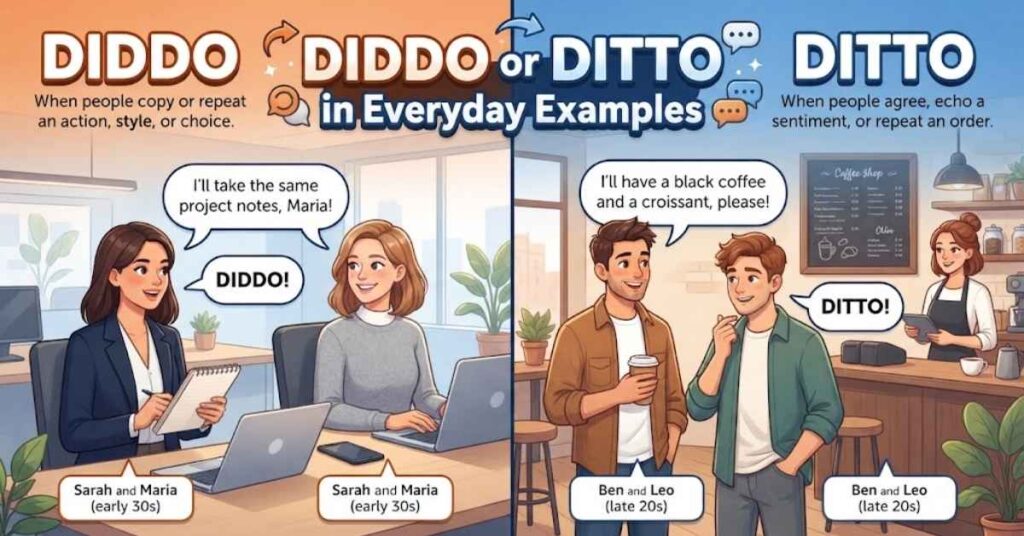
1: Casual Conversation
Maya says, “I can’t believe it’s Monday again.”
Her friend replies, “Ditto. I need coffee.”
Short, natural, and correct.
That’s casual conversation at its best.
2: Shopping List
Picture a shopping list that reads, “Apples, 6. Bananas, ditto. Oranges, ditto.”
Every fruit gets six, and you didn’t write the number three times.
It’s quick and clear.
Just keep the quantities obvious so nothing gets misread.
3: Workplace Email
Dev writes, “Please send the report by Friday.”
His manager answers, “Ditto for the slides.”
That works in a friendly workplace email between teammates.
For client messages and emails, use a fuller sentence.
4: Incorrect Usage
Now the wrong version: “Diddo, I agree with you.”
The spelling slips, and the sentence loses its polish.
Fix it to “Ditto, I agree with you.”
That small change restores writing accuracy.
Usage Data and Trends
Observations:
Exact numbers vary by tool, so treat these as patterns, not hard figures.
In search results, people often type “diddo or ditto” because they’re unsure.
Usage trends show “ditto” far ahead of “diddo or Ditto” in published text.
The wrong form lives mostly in online comments, texts, and social media posts.
Read More: Within the Week vs Within a Week: Which One Is Correct? 2026
Estimated Usage Pattern:
Here’s the rough picture across different places:
• Books, news, and dictionary pages: almost always “ditto.”
• Texts and chats: “ditto” still leads, with “diddo” popping up now and then.
• Fast social posts: the highest chance of a “diddo” typo.
These are estimates based on common patterns, not measured counts.
Still, usage frequency for “diddo” drops wherever editing happens.
Comparison Table: Diddo vs Ditto
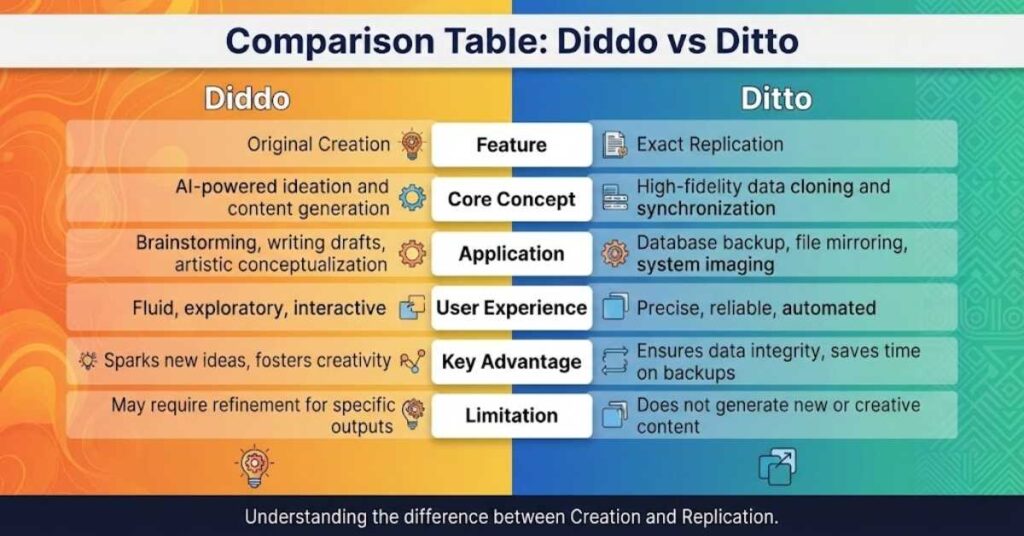
| Feature | Ditto | Diddo |
| Spelling status | Correct, standard spelling | Incorrect spelling |
| Dictionary entry | Yes | No |
| Origin | Italian “detto,” meaning “said” | None, it comes from sound alone |
| Meaning | Same as above, I agree, likewise | No meaning |
| Formal writing | Rarely suitable | Never suitable |
| UK vs US | Same spelling in both | Not a regional variant |
Real-World Case Study
Case: Workplace Communication Error
Here’s a typical scenario based on a common office slip.
A project coordinator named Priya sent a team update that said, “Diddo on the deadline, please confirm.”
She meant “same as above.”
She was typing quickly and never reread the message.
Result:
Two teammates replied with a joke about the typo.
The client, copied on the email, noticed it too.
Nobody lost the project.
But the message looked rushed, and Priya spent part of the next call explaining it.
Correct Version:
“Ditto on the deadline. Please confirm.”
Or, for a client, “The same deadline applies. Please confirm.”
Lesson:
A small spelling mistake can shape how people see you.
Proofreading takes ten seconds and saves the awkward follow up.
Ditto in Texting and Social Media
Short replies rule digital communication.
Ditto fits perfectly in a group chat, a comment thread, or a quick DM.
The trouble is speed.
When you’re typing quickly on a phone, “diddo” can slip past before you notice.
A quick glance before posting fixes it.
Ask yourself, “Does this look right?” and you’ll catch most typing errors.
Fun Facts About Ditto
One of the most famous uses came from the 1990 movie Ghost.
When Demi Moore’s character says “I love you,” Patrick Swayze’s character answers, “Ditto.”
Schools once relied on “ditto machines,” early copiers that made purple duplicates.
The name fits, since they repeated whatever was on the master sheet.
Even Pokémon fans know the name.
Ditto is the creature that copies other Pokémon, which matches the word’s meaning neatly.
Ditto vs Similar Phrases
Ditto isn’t your only option for agreeing or repeating.
Other phrases cover the same ground with a different tone.
• “Same here”: relaxed and friendly, great for everyday communication.
• “Likewise”: polite and a bit warmer than ditto, safe in most professional use.
• “Me too”: the plainest option, ideal when you want zero confusion.
• “The same applies”: the formal pick for emails and reports.
Choosing between them comes down to your reader.
A coworker you chat with daily gets “ditto.” A new client gets “the same applies.”
A Quick Self-Check Before You Hit Send
You don’t need a long routine.
Three quick questions catch most spelling errors before anyone sees them.
• Is the word spelled with two t’s?
• Does an earlier line give “ditto” something to point to?
• Does the tone match the person reading?
If the answer to all three is yes, send it.
If not, take ten seconds to fix it, because writing accuracy builds trust over time.
Expert Tip: How to Remember “Ditto”

Ditto has two t’s, just like its Italian parent “detto.”
Picture those two t’s as tally marks saying “same again.”
Another trick is to say it slowly: “dit, to.”
You’ll hear the hard “t,” and your fingers will follow.
Practical Writing Tips
Always Proofread
Reread every message before you hit send.
Spellcheck helps, but it can’t catch every contextual spelling error.
Watch for repeated errors too.
If you keep typing “diddo,” leave yourself a sticky note.
Read More: The vs Thee: Why Do So Many Writers Still Get It Wrong? 2026
Read Aloud
Say the sentence out loud.
You’ll hear awkward spots and notice where a casual word doesn’t fit.
Remember that words that sound alike can trick the ear.
So check the spelling with your eyes after you read.
Use Simple Language
Plain words win.
If ditto feels risky, write “same here” or “I agree.”
Clear writing beats clever writing.
Your reader shouldn’t need a dictionary to follow you.
Practice Regularly
Spelling sticks through repetition.
Write ditto in three sentences today.
Small habits build writing confidence over time.
You’ll be writing confidently before the week is out.
Conclusion
So, Diddo or Ditto? The answer is simple. Ditto is the correct spelling. Diddo is a typing slip. It happens because the word sounds soft when we say it fast. Now you know the reason. Next time you wonder about Diddo or Ditto, think of the two t’s. They come from the Italian word “detto.”
Use ditto in lists, chats, and notes. It means “the same” or “I agree.” Skip it in formal writing. Always read your message once before you send it. That small habit saves you from mistakes. The Diddo or Ditto problem is easy to fix. Share this guide with a friend who types too fast. Got another spelling pair that confuses you? Tell us in the comments. We’d love to help with the next one. Now you can settle the Diddo or Ditto debate with confidence.
FAQs
Q1:What does Ditto mean?
Ditto means “the same as above” or “I agree.”
It’s a shortcut to repeat the previous item without writing it again.
Q2:Is Diddo a correct spelling?
No, diddo isn’t a standard spelling.
Always write “ditto” with two t’s.
Q3:Why do people confuse Diddo and Ditto?
They sound alike when you say them fast.
The soft “t” in American speech lands close to a “d.”
Q4:Can I use Ditto in formal writing?
It’s best avoided.
Legal documents, academic writing, and formal reports need full wording.
Q5:What is a simple way to remember Ditto?
Remember the two t’s from Italian “detto.”
Picture them as tally marks that say “same again.”

Oliver Matthew Wilson is a passionate grammar writer who shares simple English lessons, vocabulary tips, writing advice, and clear guides to help readers communicate confidently.