

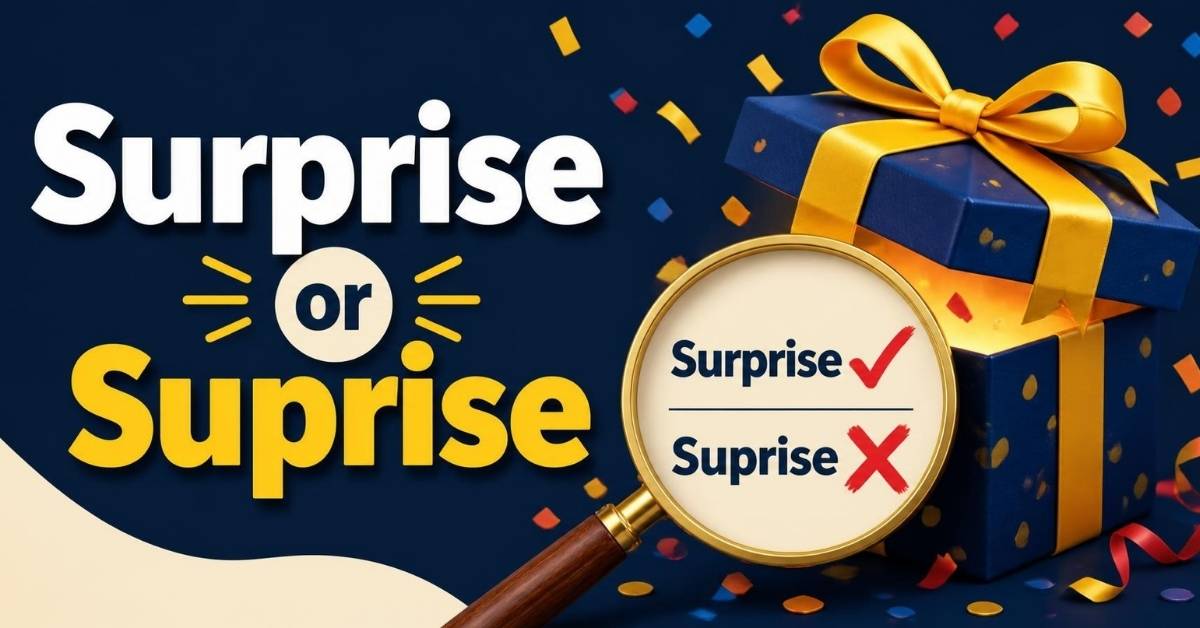
Surprise or Suprise: which one is correct? The right spelling is “surprise.” It has two r’s. Many people type “suprise” because they write what they hear. When we speak, the first r gets soft. Fast typing makes it worse. One missing letter can make a good message look careless. You may have seen this typo in a text or a birthday card.
Surprise or Suprise is a small doubt with a simple fix. This guide explains the word step by step. You’ll learn where it comes from. You’ll see why the mistake happens. You’ll also get easy tricks to remember it. We’ll look at real examples and a short case study. Reading it takes just a few minutes. Each section is quick to read. By the end, Surprise or Suprise won’t confuse you again. You’ll spell it right every time.
Suprise or Surprise – Quick Answer
Quick memory rule
Ever typed a birthday message and wondered if something looked off? You’re not alone, and the answer is simple.
The correct spelling is “surprise.” The incorrect spelling is “suprise,” and no dictionary recognition exists for it.
Here’s the memory rule in one line: SUR + RISE. Picture a surprise that makes your mood rise, and both r’s stay put.
The Origin of “Surprise”
Old French beginnings
Words carry baggage, and this one has a long trip behind it. Surprise comes from Old French, where “surprise” was the past participle of surprendre, meaning “to overtake” or “to seize suddenly.”
That verb joined “sur” (over) with “prendre” (to take), which traces back to Latin roots. You can check the word origin on Etymonline, a trusted source for historical spelling and meaning.
Think about that for a second. The first “surprise” was an attack that caught you off guard, not a party.
How spelling stabilized
English didn’t always agree with itself on spelling. Early writers tossed in extra letters or swapped endings, and “surprize” showed up in older books.
Printing presses and later dictionaries pushed things toward one form. Once spelling standardized, “surprise” won, and the r in the middle stayed.
Read More: Copys or Copies? The Spelling Trick Most People Miss in 2026
British English vs American English Spelling
The truth:
Here’s the part many people hope is different. British English and American English both write surprise, so there’s no regional difference to hide behind.
Colour and color split the two camps. Surprise didn’t, and the Merriam-Webster entry for surprise lists just one spelling for the word.
Why no variation exists
Many UK and US spelling gaps come from -ise and -ize endings. Words like organise and organize can swing either way, and that’s where surprize and suprize sneak into people’s heads.
But surprise belongs to a small club of words where “-ise” is fixed. Advertise, revise, exercise, and compromise sit in that same club, so spelling variation isn’t allowed.
Pronunciation differences (minor)
Speech does differ a little. Many Americans say “sur-PRIZE” with a clear r, while many British speakers say “suh-PRIZE” with a softer start.
That gap is tiny, and it never changes the spelling pattern. Still, those pronunciation differences explain part of the confusion, which we’ll return to shortly.
Which Spelling Should You Use?
Always use surprise
If you want a one-word answer, here it is. Use surprise in every setting, from a text to a thesis.
That covers formal writing, informal writing, and everything between. It also covers the verb (“I want to surprise you”), the noun (“What a surprise!”), and the adjective (“a surprising result”).
Never use “suprise” unless:
There are only a few safe exceptions. You can use “suprise” when you quote someone else’s typo, write about the common spelling error itself, or use a brand name that spells it that way on purpose.
Outside those cases, skip it. A creative username or a stylized logo is a choice, but a sentence in an email isn’t.
Simple rule to remember
Say the word slowly: sur-pri-se. Three beats, and the first beat holds an r.
If you hear that r, write that r. That small habit of spelling practice saves you from a lot of red squiggles.
Common Mistakes with “Surprise”

Why people write “suprise”
Most people don’t misspell it out of carelessness. They write what they hear, and everyday speech swallows that first r.
Fast typing makes it worse. Your fingers race ahead of your brain, and a common typo slips through before you notice.
Other related spelling errors
“Suprise” isn’t the only trap. Writers also trip on surprize and suprize, which mix the “-ize” ending into a word that refuses it.
Here are the usual writing mistakes around this word:
- Suprise, which drops the first r.
- Surprize, which swaps the final “s” for a “z.”
- Suprize, which makes both errors at once.
- Surpise, which loses the middle r.
Each version looks harmless on its own. Together they make up the most common spelling confusion for this word.
Interesting fact
The word started as a military term. Armies used “surprise” for a sudden attack, and the verb surprendre described someone seized before they could react.
Today we use it for gifts and good news. Not a bad glow up for a word that began on the battlefield.
“Surprise” in Everyday Examples
Correct examples
Seeing the word in action helps more than any rule. These correct usage examples show how surprise works as a noun, a verb, and an adjective:
- “The surprise party starts at seven, so please don’t text Maya.”
- “Her quick answer surprised the whole class.”
- “It was a pleasant surprise to see my old teacher in the lobby.”
- “That’s a surprising result for a first draft.”
Notice how natural each line feels. The spelling never gets in the way of the message.
Incorrect examples
Now look at the same lines with the incorrect spelling:
- “The suprise party starts at seven.”
- “Her quick answer suprised the whole class.”
- “It was a pleasant suprise to see my old teacher.”
Your eyes probably snagged on each one. That tiny snag is exactly what readers feel when they hit a spelling mistake.
Why correction matters
A typo doesn’t ruin a message, but it does shift attention. Readers stop following your idea and start hunting for the next error.
That’s a quiet hit to writing credibility. Language accuracy shows attention to detail, and people trust careful writers faster.
Mini Case Study: How a Small Spelling Error Impacts Communication
Scenario
Picture a college student named Daniel. He’s writing a cover letter for a marketing internship and wants to open with energy.
His first line says, “I’d love to suprise your team with fresh campaign ideas.” He proofreads once, sees nothing odd, and hits send.
Teacher feedback:
Before applying, Daniel had shown the draft to his writing instructor. She circled the word and wrote, “Great idea, but this typo is the first thing I noticed.”
She pointed out that hiring managers skim quickly. A spelling mistake in the opening line can overshadow the strong idea that follows.
Outcome:
Daniel fixed the word and re-read the letter aloud. He also found two other typos hiding in the second paragraph.
The corrected job application landed him an interview. He later said the proofreading step felt tiny, but it changed how his letter came across.
Key lesson:
One letter won’t sink your writing. But a clean page tells people you respect their time.
Treat proofreading and editing as part of the job, not an extra. Strong writing skills often come down to small checks like this one.
“Surprise” – Google Trends & Usage Behavior
Observed patterns
Search behavior tells a useful story here. When you explore Google Trends, you’ll often see people typing the misspelling into the search bar before they correct themselves.
Searchers also tend to pair the word with phrases like “how to spell” or “correct spelling.” That pattern shows real spelling confusion, not just random typos.
You can run this check yourself on Google Trends and compare both forms. I’d rather you see the live curve than trust a number I quote from memory.
Informal vs formal usage
The typo shows up most in quick, casual spaces. Think online messages, social media captions, comments, and group chats.
In formal writing the word is usually fine. Editors, teachers, and spelling checker tools catch the slip before it reaches readers.
Read More: Is “As Always” Correct English? Easy Rules & Examples 2026
Insight
Here’s the takeaway. The error lives where speed beats care, so casual communication is where you should slow down.
Search engines also notice. A search engine correction often says “Showing results for surprise,” which quietly confirms the right form.
Why “Suprise” Feels Correct (Even When It Isn’t)
The phonetic illusion
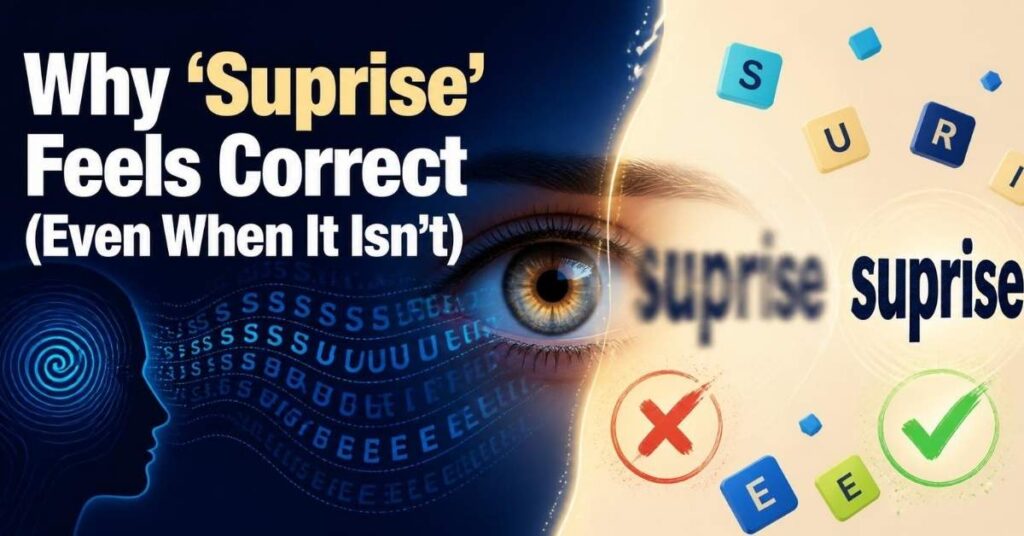
Your brain loves shortcuts. When you say the word aloud, the first r blends into the next sound, so “sur-prise” starts to sound like “suh-prise.”
That’s the phonetic illusion at work. Phonetic spelling makes sense for sound, but English doesn’t always follow sound, and that’s where pronunciation habits lead us astray.
Add one more layer. You’ve probably seen “suprise” so often online that it begins to look normal, and spelling habits grow from repeated exposure.
Simple Analogy to Remember It
Think of surprise as a sandwich. The two r’s are the bread, and the “p” sits in the middle holding everything together.
Pull out one slice and the whole thing falls apart. That’s what happens to the word when the first r goes missing.
Here’s another picture. A surprise is something that makes you rise from your seat, so SUR + RISE keeps the ending honest.
Quick Tricks to Never Misspell It Again
Trick 1: Split it visually
Break the word into chunks: sur + prise. Seeing two clear pieces makes it harder to skip a letter.
Write it that way on a sticky note for a week. Your eyes will pick up the spelling pattern without any effort.
Trick 2: Say it slowly
Slow your pronunciation down on purpose. Say “sur, pri, se” and tap your desk on each beat.
This works well for English learners and students. Hearing the r once makes it far easier to type it.
Trick 3: Word association
Link the word to something that sticks. Try “SUR + RISE” or “I sure like a surprise” (sure and sur both start with the same sound).
Use whichever memory trick feels most you. The best memory rules are the silly ones, because silly sticks.
Comparison Table – “Suprise” vs “Surprise”
| Feature | Surprise | Suprise |
| Spelling status | Correct | Incorrect |
| Found in dictionaries | Yes | No |
| Accepted in British English | Yes | No |
| Accepted in American English | Yes | No |
| Fits professional writing | Yes | No |
| Where the error comes from | Not applicable | Dropped first r |
Why English Keeps Silent Letters Like This
English spelling often feels like it ignores the rules. Letters we barely say, like the first r in “surprise” or the b in “doubt,” stay because they record a word’s history.
Spelling froze while speech kept moving. That’s why old Latin roots and Old French shapes still sit inside words we say every day.
This can feel unfair, especially for English learners. But once you know the story behind a word, the odd letters start to feel like clues instead of traps.
Read More: Geez vs Jeez: Which Spelling Is Right? Find Out in 2026
Common Writing Situations Where This Error Appears
You’ll spot this mistake in a few predictable places:
- Emails written between meetings.
- Social media posts typed on a phone.
- Birthday cards and party invites.
- Group chats where speed matters most.
- Daily writing like notes, captions, and quick replies.
Each setting rewards speed over accuracy. That’s why the common spelling error thrives there.
Why it matters in professional settings
At work, small slips travel far. A typo in a client email, a pitch deck, or professional reports can make a sharp idea look rushed.
Hiring teams read job applications quickly and notice errors fast. Clean writing signals communication skills and care, which both build trust.
Spell Checkers, Auto-Correct, and Why You Can’t Lean on Them
Most tools catch “suprise” right away. Auto-correct and any decent spelling checker will underline it or swap it automatically.
But digital writing has gaps. A phone might ignore a typo in a username, a hashtag, or a text field with no checker turned on.
So treat tools as backup, not a plan. Build your own proofreading habits, and read your message once before sending it.
Surprise as a Word Family: Verb, Noun, and Adjective
Once you lock in the base spelling, the rest gets easy. The same two r’s carry through the whole family:
- Surprise (noun and verb)
- Surprised (past tense and adjective)
- Surprising (adjective)
- Surprisingly (adverb)
- Unsurprising (the opposite)
Every form keeps the same core. If the base word is right, the rest follows, which is a nice bonus for spelling rules.
Conclusion
Surprise or Suprise? Now you know the answer. The correct spelling is “surprise.” It has two r’s. The typo “suprise” comes from sound and speed. We say the word fast, so the first r fades. Then our fingers copy that sound. No dictionary accepts “suprise.” Not in British English. Not in American English. So Surprise or Suprise has only one right answer.
Surprise or Suprise is easy to fix with a few habits. Remember SUR plus RISE. Say the word slowly. Check your spelling before you hit send. Small checks build trust. They show you care about your readers. Next time Surprise or Suprise pops up, you’ll know what to do. Share this guide with a friend who makes this typo. Got a word that always trips you up? Tell us in the comments. We’d love to hear it now.
FAQs
Q1: What is the correct spelling: Suprise or Surprise?
Surprise is the correct spelling. “Suprise” is a common typo that no dictionary accepts.
Q2: Why do people write “suprise” instead of “surprise”?
People spell what they hear. Because everyday speech softens the first r, the phonetic illusion makes “suprise” feel right.
Q3: Is “suprise” accepted in British or American English?
No, it isn’t accepted in either. Both British English and American English use surprise, so there’s no spelling variation to lean on.
Q4: How can I remember the correct spelling of Surprise?
Use the SUR + RISE trick. You can also split it as sur + prise and say it slowly to hear both r’s.
Q5: Why is correct spelling important in writing?
Correct spelling builds trust and keeps readers focused on your message. It shows attention to detail, which matters in emails, academic writing, and every kind of professional writing.

Oliver Matthew Wilson is a passionate grammar writer who shares simple English lessons, vocabulary tips, writing advice, and clear guides to help readers communicate confidently.