


Genius vs Genious is a spelling mix up many people face. You type fast. The word looks fine. You hit send. Then someone spots the typo. Awkward, right? It happens to everyone. Don’t worry. Here’s the quick, simple answer. Genius is the correct spelling. Genious is a mistake. No dictionary lists it.
In this guide, we’ll clear up Genius vs Genious for good. You’ll learn what genius means. You’ll see why people write it wrong. We’ll also share easy tricks to remember it. Each one takes seconds to learn. You’ll also see real examples and common phrases. Plus, we’ll cover how genius differs from ingenious. By the end, Genius vs Genious won’t confuse you again. We’ll keep it short and simple. No boring grammar lectures. Just clear answers you can use today. Ready to fix this spelling habit? Let’s start.
Genius vs Genious: Which Spelling Is Correct?
Genius wins, with an “-ius” ending. That’s the correct spelling of genius in every major dictionary.
Genious isn’t a British variant or an old form. It’s a typo that keeps getting copied.
Run the genius vs genious spelling check yourself. Search any dictionary and you’ll see only one headword.
Is “Genious” a Real Word?
No. Is genious a word? Not in English. Merriam-Webster, Cambridge Dictionary, Oxford English Dictionary, Collins Dictionary, and the American Heritage Dictionary all skip it.
That makes genious meaning a dead end. Readers will assume you meant “genius” or “ingenious,” and your point gets muddy.
Why Does It Appear So Often?
Plenty of people type it, so the wrong version looks familiar. Familiar spellings feel safe, even when they’re not.
Spell-check catches most slips. Still, a rushed text or a copied caption can sneak through and spread.
What Does “Genius” Mean?
The genius meaning covers three everyday uses. You’ll meet all of them in books, news, and chat.
Each one points to exceptional intelligence or remarkable natural talent. Here’s the split.
A Person With Exceptional Intelligence
Here genius names a person. Their exceptional intellectual ability sits far above average.
Your friend who solves a Rubik’s cube in under a minute might get the label as a joke. A physicist who reshapes a field earns it for real.
Extraordinary Creative Ability
Sometimes genius names the gift itself. A critic might say a painter “has genius” when her creative ability feels impossible to teach.
It’s less about test scores and more about outstanding talent. You can’t fake it.
An Exceptionally Clever Idea
A brilliant idea can also be called genius. Someone clips a binder clip to a desk to hold a phone, and you say, “That’s genius.”
Now the word describes the idea, not the person. It’s the most casual use in modern English.
Dictionary Definitions of Genius
The dictionary definition of genius usually lists two main senses. One is extraordinary intelligence or creative power. The other is a person who has it.
Some entries add an older sense: a guardian spirit in Roman belief. Every one of the standard dictionaries spells it the same way.
Test it in under a minute. Look up “genius,” then look up “genious,” and compare what you find.
Why Do People Spell “Genius” as “Genious”?
There’s no single culprit. Four habits work together, and you’ll probably spot yours.
Once you see the pattern, you’ll catch the slip faster.
English Pronunciation Can Be Misleading
Say it out loud: “JEEN-yus.” That “yus” sound hides the vowels. Your brain may add an “o” to fill the gap.
English pronunciation and spelling rarely match. Guessing by sound causes classic phonetic spelling errors.
Similar Words Cause Confusion
Think of curious, serious, obvious, and delicious. Those words are everywhere, so your eyes expect them.
That -ious ending pulls “genius” into the same mold. It’s common suffix confusion, not a knowledge gap.
Phonetic Spelling Habits
Many of us learned to sound words out. That works for “cat” and “stop” but fails on words with Latin roots.
If you lean on early spelling patterns, you’ll sometimes spell by ear. It’s human, and it’s fixable.
Typing and Autocorrect Errors
Fingers move faster than eyes. Your thumb adds an “o” before the “s” and you never notice.
Spell-check software helps, but it can accept a made-up word you’ve saved to your dictionary. Check that list now and then.
The Origin and Etymology of Genius
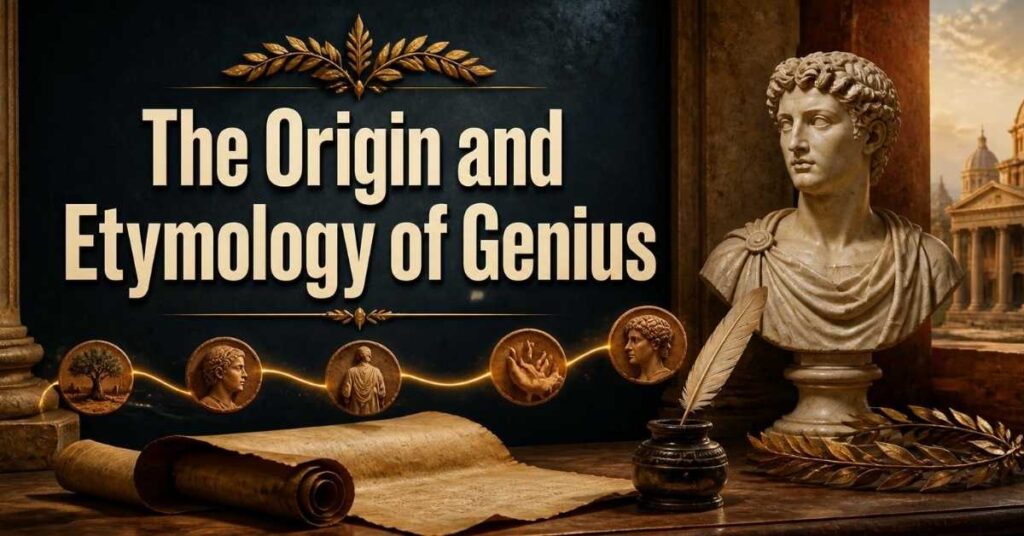
The origin of the word genius is Latin. The Latin word genius grew from “gignere,” which means “to beget” or “to give birth.”
Romans used it for a guardian spirit that watched over a person from birth. Places had one too.
Evolution of the Word
English borrowed it in the late Middle Ages with that spirit sense. Later it drifted toward a person’s natural disposition.
Look at the genius etymology and you’ll notice something handy. The “-ius” ending never changed.
How the Meaning of Genius Changed
First, it was a spirit that guided you. Around the 1600s, it described your inborn bent or talent.
By the 1700s, writers used it for intellectual power and creative brilliance. Scholars of historical word development often point to that shift.
Today you use it for people and ideas. Notice how changes in word meaning often move from the supernatural to the personal.
How to Remember the Correct Spelling of Genius
You don’t need to be a spelling champion. A few small tricks do the job.
Try each one and keep whichever clicks.
Trick One: Think of the Ending
End with “-ius,” the same way Julius does. There’s no “o” hiding anywhere.
Say the last three letters slowly: i, u, s. They’re short and simple.
Trick Two: Famous Phrase Method
Tie the word to a phrase you know. “Einstein was a genius” is easy to picture and repeat.
Write that sentence once by hand. Your spelling memory trick sticks better than reading alone.
Trick Three: Visual Memory
Look at the word: g, e, n, i, u, s. Six letters, with no “o” anywhere.
Picture the “iu” pair in the middle as a tiny bridge. Hold the image for ten seconds, and use visual memory techniques like this for other tricky words too.
Trick Four: Dictionary Rule
When in doubt, look it up. It takes five seconds and builds the habit.
Build a spelling verification routine: draft, scan for tricky words, then check them in a standard dictionary.
How to Pronounce Genius Correctly
Say JEEN-yus. The first syllable rhymes with “mean,” and the second sounds like “yus.”
Stress the first syllable. Keep it quick, two beats and not three. That’s the right genius pronunciation in both American and British English.
Examples of Genius Used Correctly
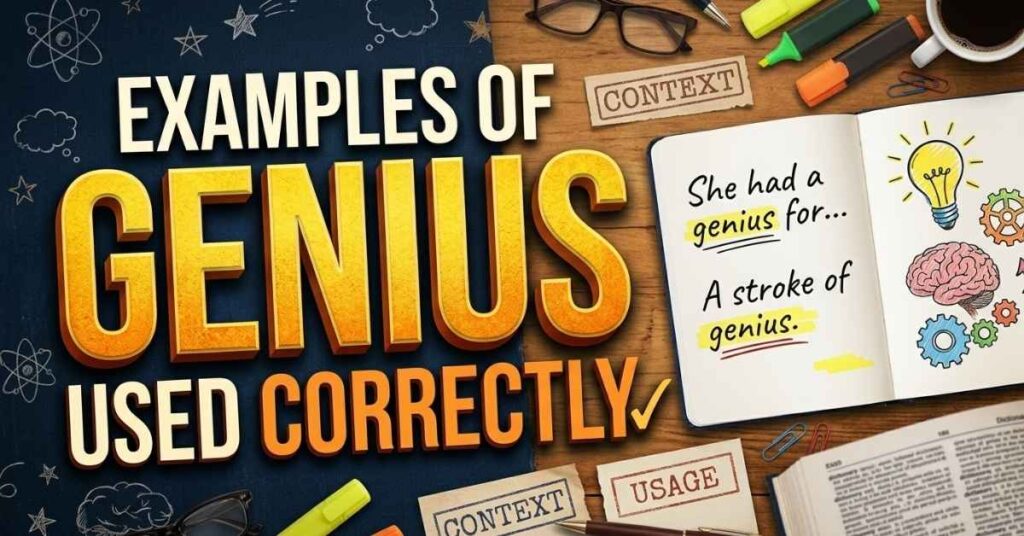
Seeing a word in action beats memorizing rules. These genius example sentences cover the main uses.
Read each one aloud. You’ll feel the rhythm of the correct form.
Referring to a Person
“My physics teacher is a genius with equations.” It’s short, clear, and natural. That’s genius in a sentence at its simplest.
Another one: “She’s a math genius who grades papers in her head.”
Referring to an Idea
“Using a binder clip as a phone stand was genius.” The word praises the idea, not a person.
You’ll hear it in offices, classrooms, and kitchens. It fits casual and professional talk.
Referring to Creativity
“The film shows real genius in how it uses silence.” Here genius points to creative ability itself.
You’ll often read this in reviews about artistic genius or musical genius.
Examples of Genious Used Incorrectly
Spotting the mistake helps you avoid it. Here are three wrong sentences.
- “He’s a genious at chess.”
- “That was a genious idea.”
- “Her genious shows in every song.”
Each one should read genius. If you find this genius spelling mistake in a draft, fix it before you hit send.
Genius as a Noun and Adjective
Genius works as a noun in most cases. In casual talk it also works as an adjective.
Dictionaries mostly label it a noun. Modern speech treats it as both, so let’s cover each.
Genius as a Noun
As a noun, it names a person or a quality. “She’s a genius.” “He showed genius.”
The plural is geniuses. Use “genii” only when you mean spirits, which is rare.
Genius as an Adjective
As an adjective, it describes things. “A genius plan.” “A genius solution.”
This use is informal but common. In formal writing, “brilliant” or “ingenious” may feel safer.
Comparison Table
| Use | Example | Meaning |
| Noun (person) | “She’s a genius.” | A person of exceptional ability |
| Noun (quality) | “It shows genius.” | Natural gifts or talent |
| Adjective | “A genius idea.” | Clever or brilliant |
Common Phrases That Use the Word Genius
A few phrases show up again and again. Learn them and your writing sounds more natural.
Each one carries its own flavor.
Child Genius
A child genius shows advanced skills early. Picture a seven year old playing complex piano pieces.
The phrase sounds admiring, though it can add pressure for kids.
Evil Genius
An evil genius is a clever villain. Movies love this one.
It’s playful more often than serious.
Comic Genius
A comic genius makes people laugh in sharp, original ways. Think of a stand up who turns a small moment into a big laugh.
You’ll see it in reviews and tributes.
Engineering Genius
An engineering genius solves hard design problems with simple moves. A bridge that uses less steel yet stands stronger is a good example.
It’s also a common tag for a brilliant solution story.
Stroke of Genius
A stroke of genius is a sudden clever idea. It’s the “aha” moment.
Use it when the idea feels both simple and surprising.
Example Sentences
- “Moving the desk by the window was a stroke of genius.”
- “Her comic genius filled the room with laughter.”
- “He’s an engineering genius who fixed the bug in ten minutes.”
- “They called the seven year old a child genius after her chess win.”
Famous People Often Called Geniuses
History offers plenty of examples. These four come up in nearly every chat about genius.
Each one shows a different side of exceptional intelligence and creativity.
Albert Einstein
Albert Einstein reshaped physics with the theory of relativity. His work changed how we see time, space, and gravity.
He won the Nobel Prize in Physics in 1921. Many people use his name as shorthand for mathematical genius.
Leonardo da Vinci
Leonardo da Vinci painted the Mona Lisa and filled notebooks with designs for flying machines. He mixed art, anatomy, and engineering.
That range is why people call him a creative genius.
Wolfgang Amadeus Mozart
Wolfgang Amadeus Mozart began composing as a young child. By his death at 35, he had written hundreds of works.
He’s the classic example of natural ability at work.
Marie Curie
Marie Curie won Nobel Prizes in both Physics and Chemistry. She pioneered research on radioactivity.
Her story shows genius mixed with grit and long hours in the lab.
Case Study: Why Einstein Became the Definition of Genius
In 1905, Einstein published several groundbreaking papers, including his work on special relativity. People often call that stretch his miracle year.
A decade later, in 1915, he completed general relativity. Later experiments backed its predictions, which boosted his fame.
Timing mattered too. Newspapers wanted a clear face for big science, and his wild hair and sharp wit gave them one.
The lesson is simple. Genius gets recognized when intellectual power meets proof, a story, and a bit of luck.
Genius vs Ingenious: Don’t Confuse These Words
Genius vs ingenious trips up many writers. The words look close and sound close, yet they work differently.
Genius names a person or a gift. Ingenious describes something clever, original, or resourceful. That’s the core genius vs ingenious difference.
Pronounce them differently too. Ingenious is “in-JEEN-yus.”
Examples
- “He’s a genius.” (a person)
- “That was an ingenious trick.” (a clever thing)
- “Her ingenious plan saved the project.” (a clever plan)
- “Her genius saved the project.” (her gift)
Ask yourself one question. Am I describing a gift, or a clever result?
Commonly Misspelled Words Like Genius
Genius isn’t alone. Plenty of commonly misspelled words trip people up.
- Necessary (one “c,” two “s”)
- Definitely (not “definately”)
- Separate (not “seperate”)
- Occasion (two “c,” one “s”)
- Embarrass (two “r,” two “s”)
- Receive (i before e, except after c)
All of these are common spelling mistakes. Most come from guessing by sound, just like genious.
Why English Spelling Is So Difficult
English borrowed words from Latin, French, German, and more. Each kept some of its old spelling, and nobody tidied them up.
Add centuries of sound changes, and you get messy English spelling rules with many exceptions. Even native English speakers miss them.
That’s good news for English learners. You’re not failing. You’re wrestling with a quirky system.
How to Avoid Spelling Mistakes in Professional Writing
One wrong word in a pitch deck can make a client wonder what else you missed. Typos chip away at trust.
Strong professional writing accuracy comes from simple habits. You don’t need fancy tools.
Best Practices
- Proofread after a short break, not right away.
- Read your draft aloud to catch odd words.
- Run spell-check software, then double check names and rare terms.
- Keep a short list of words you often miss.
- Check unsure words in a standard dictionary.
These proofreading techniques work for emails, reports, and blogs. Clear writing clarity builds credibility.
Quick Rules to Remember
Here’s your cheat sheet. Save it or screenshot it.
Short rules are easy to recall when you’re in a hurry.
Use Genius When:
- You mean a person with exceptional intelligence.
- You mean creative ability or natural gifts.
- You mean a brilliant idea or clever move.
- You need the plural, geniuses.
Never Use Genious
- It isn’t a word in standard English.
- It’s not a British variant.
- It’s a genius spelling mistake in every context.
FAQs
1. Is “Genious” a correct spelling?
No. Genious correct or incorrect? It’s incorrect. The right spelling is genius.
2. Why do people misspell “Genius” as “Genious”?
Pronunciation, similar “-ious” words, and typing slips cause it. It’s a pattern error, not a lack of intelligence.
3. What does the word “Genius” mean?
It means a person of extraordinary intelligence, a gift of creative ability, or a clever idea. Context tells you which one.
4. Is “Genius” used in both American and British English?
Yes. American English spelling and British English spelling are identical for this word.
5. How can I remember the correct spelling of “Genius”?
Picture the “-ius” ending, link it to “Einstein was a genius,” and write it by hand once.
Conclusion
Genius vs Genious is an easy fix once you know the rule. Genius is the correct spelling. Genious is a typo. No dictionary accepts it. Remember the “ius” ending. Think of Einstein, and you won’t slip. That’s the heart of Genius vs Genious.
Now you know the meaning, the origin, and the common traps. You also have four simple tricks. Use them whenever you write. They take only seconds. Proofread before you hit send. Small habits save you from big typos. Genius vs Genious won’t catch you again. Did this guide help? Tell us in the comments. Share it with a friend who still writes genious. Genius vs Genious is a small topic. Yet clear spelling builds trust with every reader. Keep this page handy. It’s that simple. Come back anytime you need a quick check on Genius vs Genious.

Oliver Matthew Wilson is a passionate grammar writer who shares simple English lessons, vocabulary tips, writing advice, and clear guides to help readers communicate confidently.