

Sence vs Sense is a mix up many writers face. You type fast. Your fingers pick the wrong letter. Then a red line shows up. Now you wonder which spelling is right. Here’s the short answer. Sense is correct. Sence is not a real word. No dictionary lists it. So you can stop doubting yourself.
This guide clears up Sence vs Sense in plain words. You’ll see what sense means. You’ll see why people misspell it. You’ll also get easy tricks to remember it. Each tip is short and simple. Why does the Sence vs Sense question come up so often? English spelling is full of odd rules. The same sound can use different letters. That’s where the trouble starts. Let’s fix it together. Read on, and you’ll never second guess it again. Your writing will look much sharper too.
Quick Answer: Sence vs Sense
The right word is sense, spelled S-E-N-S-E.
“Sence” is a misspelling, plain and simple.
So if you’re asking “is sense or sence correct,” write sense.
It works for every meaning, from common sense to the sense of smell.
Is “Sence” a Real Word?
No, sence isn’t a word in standard English.
You won’t find it in any major dictionary, so it counts as an incorrect spelling.
People ask “is sence a word” because it looks believable.
It mirrors words like “fence,” which makes the sence misspelling easy to miss.
That also means sence meaning searches lead nowhere.
The word has no meaning of its own.
What Does “Sense” Mean?
The meaning of sense shifts with context.
Think understanding, good judgment, a bodily ability, or a feeling.
Here’s a short sense definition: the ability to perceive, understand, or judge something.
Sense pronunciation is simple too, since it sounds like “sens” and rhymes with “fence.”
Sense as Understanding
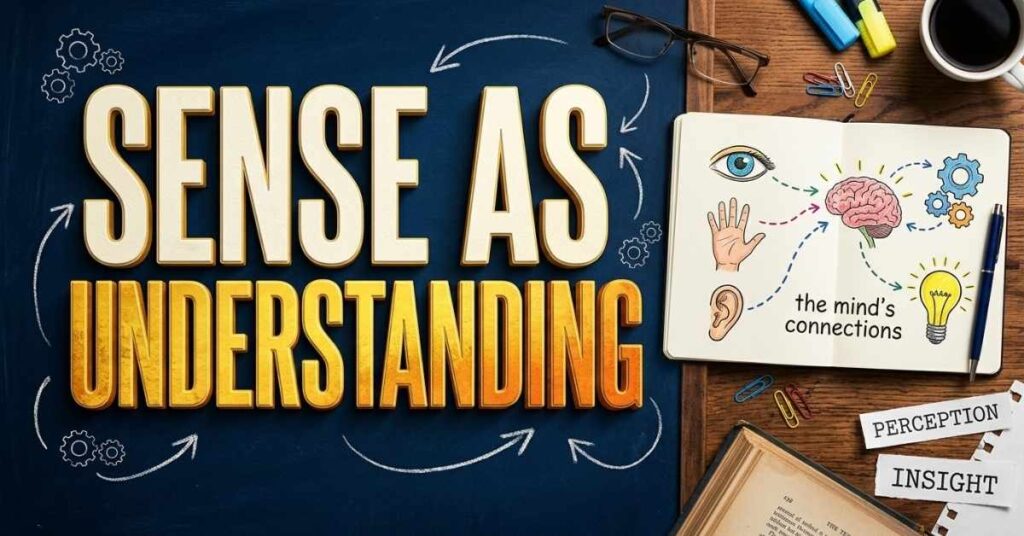
When something clicks in your head, that’s sense and understanding at work.
It’s the most common use of the word.
Examples
- “The instructions finally made sense.”
- “I can’t make sense of this chart.”
- “Her story makes perfect sense.”
Example in Everyday Life
Picture a friend explaining why her phone bill doubled.
Once she mentions the roaming charge, it all makes sense.
Sense as Good Judgment
Sometimes sense means good judgment, the practical wisdom that keeps you out of trouble.
It’s the voice that says don’t text your boss at 2 a.m.
Examples
- “He had the sense to double check the invoice.”
- “There’s no sense in arguing about it.”
Common Expressions
You’ll hear common sense everywhere, plus business sense and financial sense.
Phrases like “talk sense” and “knock some sense into him” belong here too.
Sense as One of the Five Senses
Your body runs on five human senses: sight, hearing, smell, taste, and touch.
Together they power your sensory perception.
Examples
- “A dog’s sense of smell beats ours by miles.”
- “Her sense of hearing sharpened in the quiet house.”
- “Cold coffee dulls the sense of taste.”
Sense as a Feeling or Awareness
This use is about awareness, a hunch or intuition you can’t fully explain.
It often points to emotional awareness more than logic.
Examples
- “I had a sense that something was off.”
- “She felt a sense of relief.”
- “There was a sense of excitement in the room.”
Why Do People Write “Sence” Instead of “Sense”?
English spelling is messy, and English spelling inconsistencies trip everyone up.
The “s” sound at the end of a word can come from c, s, or ss.
Look at fence, dense, tense, and sense.
Fence uses a “c” while the others use “s,” so why people spell sense incorrectly isn’t a mystery.
Fast typing adds to the problem.
On autopilot, your fingers grab the wrong letter and you never notice.
Compare These Words
| Ending | Words |
| -nse | sense, dense, tense, intense |
| -nce | fence, silence, absence, science |
The History of the Word “Sense”

Sense comes from the Latin word sensus, meaning feeling or perception.
That traces back to the Latin verb sentire, “to feel.”
The word passed through Old French (sens) and reached Middle English in the late 1300s.
The “e” stayed, and a “c” never showed up.
Word History Timeline
| Stage | Form | Meaning |
| Latin | sensus | feeling, perception |
| Old French | sens | meaning, judgment |
| Middle English | sense | ability to perceive, meaning |
| Modern English | sense | all of the above, plus a verb |
How to Remember the Correct Spelling of Sense
Three memory tricks for spelling make how to spell sense correctly automatic.
Pick the one that sticks.
Trick One: Think About the Five Senses
Sight and smell both start with S, and so does sense.
Keep the C out of it.
Trick Two: Memorize the Phrase “Makes Sense”
You’ve seen “makes sense” a thousand times.
Picture it and the S wins.
Trick Three: Remember the Latin Root
The Latin root, sensus, has no C.
If the root skips it, so should you.
Examples of Sense in Sentences
Seeing sense in a sentence locks it in.
Here are sense usage examples sorted by meaning.
Understanding
“Does this recipe make sense to you?”
Judgment
“She had the sense to leave early.”
Feeling
“He felt a sense of pride when the doors opened.”
Physical Ability
“A cold can dull your sense of smell.”
Common Phrases That Use the Word Sense
These phrases pop up in everyday conversations all day long.
Learn them once and you’ll spot them everywhere.
Common Sense
It means practical judgment most people share.
“It’s common sense to lock the door.”
Sense of Humor
It’s your ability to see what’s funny.
A good one gets you through a bad Monday.
Sense of Direction
It’s knowing where you are and which way to go.
Some people never need GPS.
Sense of Purpose
It’s the feeling that your effort matters.
Related phrases include sense of responsibility, sense of belonging, and sense of duty.
Make Sense
It means to be logical or clear.
“That makes sense” is the everyday version.
In a Sense
It means “in some way.”
“In a sense, it’s a fair price.”
Sense as a Noun and a Verb
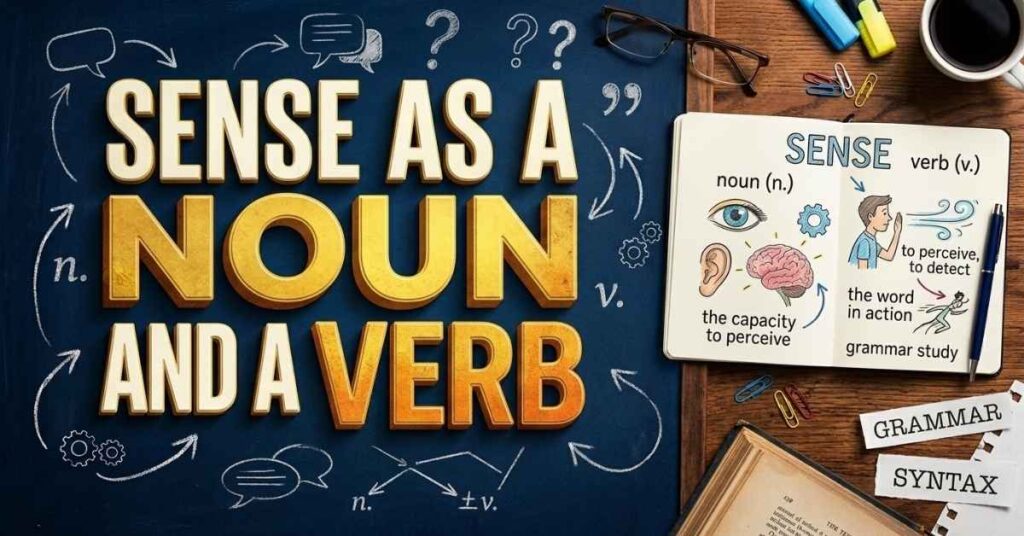
Sense as a noun and sense as a verb both exist.
The spelling never changes.
Sense as a Noun
As a noun, it names an ability, a feeling, or a meaning.
“She has great business sense.”
Sense as a Verb
As a verb, it means to detect or feel something.
“Dogs sense fear.” The forms are sense, senses, sensed, and sensing.
Synonyms of Sense
Swap the word when you need variety.
Just match the synonyms of sense to the meaning you want.
Sense Meaning Understanding
Try comprehension, grasp, or insight.
Sense Meaning Awareness
Try perception, consciousness, recognition, or intuition.
Sense Meaning Judgment
Try wisdom, prudence, intelligence, or reasoning.
Antonyms of Sense
The opposites are nonsense, foolishness, and irrationality.
For the physical meaning, think numbness.
Example
“Skipping sleep before an exam is nonsense.”
“His plan was pure foolishness.”
Common Mistakes to Avoid
These common mistakes when spelling sense show up in emails and posts all the time.
A quick glance at each pair will fix the habit.
Incorrect
“That doesn’t make sence.”
Correct
“That doesn’t make sense.”
Incorrect
“She has a great sence of humor.”
Correct
“She has a great sense of humor.”
Incorrect
“Use some common sence.”
Correct
“Use some common sense.”
Case Study: Why Spell Checkers Flag “Sence”
Type “sence vs Sense” in any word processor and a red line appears.
The spell checker compares it to its dictionary and finds no match.
Most tools then suggest sense first, since it’s the closest real word.
That’s how spell checkers identify spelling errors in most cases.
But they miss some slips.
“That doesn’t make since” sails through because “since” is a real word.
So you still need to proofread by eye.
Words Commonly Confused With Sense
| Word | Meaning | Example |
| sense | ability to perceive or judge | She has good sense. |
| cents | coins | It costs fifty cents. |
| scents | smells | The shop has lovely scents. |
| since | from then, or because | I’ve waited since noon. |
| census | an official count | The census starts in spring. |
Why the Phrase “Makes Sense” Is So Popular
It’s a quick way to say “I get it.”
People use it constantly in everyday conversations.
It also fits professional communication.
“That makes sense, so let’s move forward” works in a meeting or a chat.
Examples
- “That makes sense.”
- “Does that make sense?”
- “It makes sense to wait a day.”
Interesting Facts About the Word Sense

This small word carries a lot of history.
Here are three facts worth sharing.
The Word Is Ancient
Its roots reach back more than two thousand years to classical Latin.
It Has Many Meanings
Dictionaries list a long run of meanings across noun and verb uses.
It Appears in Thousands of Phrases
From sense of humor to sixth sense, it turns up in countless phrases.
Quick Self Check: Pick the Right Spelling
Try these three before you move on.
Cover the answers first.
- “Her sense / sence of direction is amazing.” Answer: sense.
- “That plan makes no sense / sence.” Answer: sense.
- “Use common sense / sence.” Answer: sense.
Why Learning the Difference Between Sence and Sense Matters
Correct word choice builds trust.
Readers judge writing accuracy within seconds.
Professional Writing
A typo in a client email can make you look careless.
Academic Work
Teachers mark spelling errors in English, and academic writing expects formal writing polish.
Online Content
Misspellings can hurt credibility and reader trust.
Job Applications
Recruiters skim fast, so “sence vs Sense of responsibility” on a resume can cost you a callback.
FAQs
1. Is “sence” a correct English word?
No, it isn’t.
The correct spelling is sense.
2. What does “sense” mean?
It means understanding, good judgment, a bodily ability, or a feeling.
It also works as a verb meaning to detect.
3. Why do people spell “sense” as “sence”?
The two sound identical.
Words like fence also use a “c,” so the mix up feels natural.
4. How can I remember the correct spelling of “sense”?
Think of the five senses, repeat “makes sense,” or recall the Latin root sensus.
None of them has a C.
5. Can using “sence” affect my writing?
Yes, it can.
It hurts credibility in emails, essays, resumes, and online posts.
Conclusion
The Sence vs Sense debate has a simple ending. Sense is the right spelling. Sence is just a typo. Now you know why people mix them up. You also know how to fix it. Think of the five senses. Say “makes sense” out loud. Remember the Latin root too. Any one trick will do. Sence vs Sense won’t fool you again.
Good spelling builds trust. Readers notice small mistakes. Whether you write emails, essays, or posts, Sence vs Sense matters. Check your work before you hit send. Keep this guide handy for quick help. Did Sence vs Sense ever trip you up? Tell us in the comments. Share this post with a friend who needs it. Small fixes make a big difference. Keep writing with confidence. Sense is the word you want. Sence never belongs in your writing. That’s it.

Oliver Matthew Wilson is a passionate grammar writer who shares simple English lessons, vocabulary tips, writing advice, and clear guides to help readers communicate confidently.