

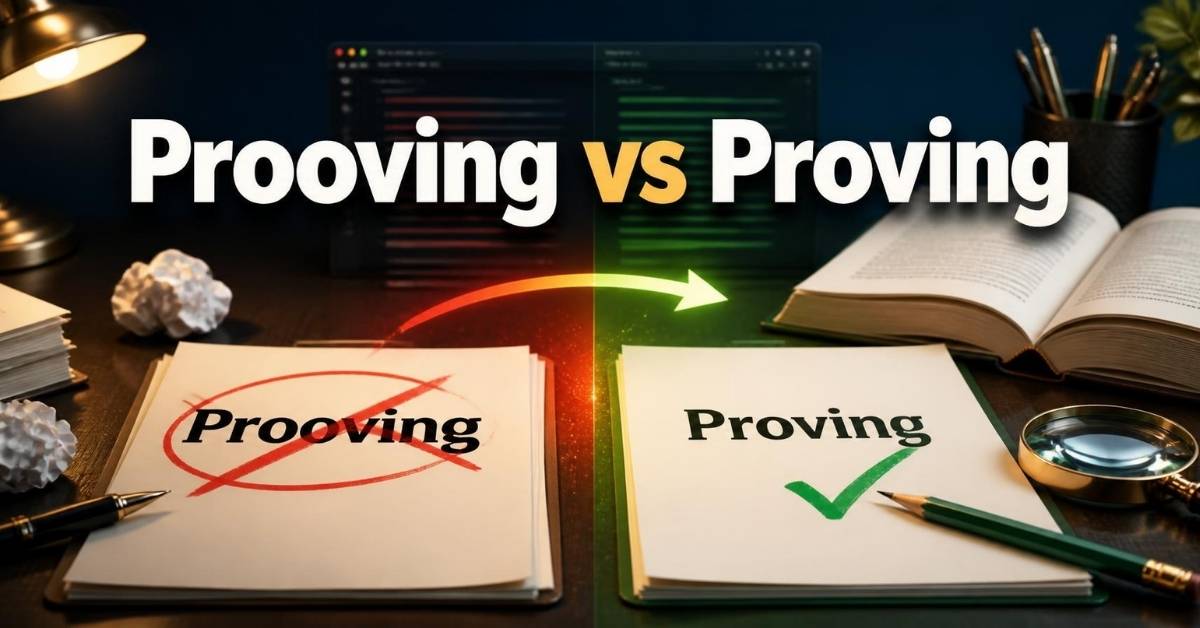
Prooving vs Proving is a spelling problem many writers face. You hear the word and type what sounds right. That’s how an extra O sneaks in. It happens in emails, essays, and social posts. So which one is correct? Proving is the right spelling. Prooving is just a mistake. It isn’t a real English word. Don’t worry if you’ve made it. Even careful writers do.
Prooving vs Proving confusion has a very simple cause. The word prove ends in a silent E. When you add ing, you drop that E. That’s all there is to it. You don’t add another O. In this guide, you’ll learn the rule in plain steps. You’ll also see easy examples and a quick trick. Soon, the Prooving vs Proving question won’t bother you again. Each part is short and easy to follow. Let’s begin.
Why So Many People Write “Prooving” Instead of “Proving”
Ever stared at a word until it suddenly looked wrong?
That happens with prooving vs proving more often than you’d think.
The word prove sounds like it has a long oo vowel.
Writers hear that sound and assume the spelling needs two O’s.
Your brain also links prove with proof, which really does have a double O.
So the slip feels logical, even though it breaks English spelling rules.
The Silent E Is the Real Culprit
Prove ends in an E that you never pronounce.
That letter is the silent E, and it sits at the heart of this whole mix-up.
When you add ing to a verb ending in E, English drops that E first.
So prove becomes prov, and prov plus ing gives you proving.
Writers who skip this step still hear the old vowel sound.
They try to show it by doubling the O, and prooving is born.
The Complete Conjugation of “Prove”
| Form | Word | Example |
| Base form | prove | I’ll prove it tomorrow. |
| Third person | proves | She proves her point fast. |
| Past tense | proved | He proved me wrong. |
| Past participle | proved or proven | It has been proven twice. |
| Present participle | proving | We’re proving it right now. |
| Gerund | proving | Proving a theory takes time. |
Proved vs Proven: The Other Confusion Worth Clearing Up
This pair creates a second round of commonly confused words trouble.
Both are accepted, but they don’t always swap freely.
Proved is the simple past tense, and it also works as a participle.
Proven is a participle too, plus a popular adjective.
Neither one is wrong in the right spot.
Let’s look at where each one fits best.
When to Use “Proved”
Use proved for a finished action in the past.
For example, “The test proved the idea wrong.”
It also works after has or have, especially in British English.
You’ll often see “She has proved her worth” in UK newspapers.
When to Use “Proven”
Use proven before a noun, like a proven method or a proven track record.
It reads as an adjective there, and proved sounds a bit clumsy.
Proven also fits set phrases, such as innocent until proven guilty.
American English leans on it for the participle as well.
Scottish courts even have a verdict called “not proven.”
It’s a rare case where this spelling carries legal weight.
Words That Actually Follow the Doubled-O Pattern
Doubled O’s are real, but they belong to other verbs.
These verbs end in oo, so both letters already sit in the base word.
• Booing comes from boo.
• Mooing comes from moo.
• Wooing comes from woo.
• Shooing comes from shoo.
• Cooing comes from coo.
Nothing gets dropped when you add ing to these words.
There’s no silent E to remove, so both O’s stay.
Prove plays by a different rule.
Its O sits before a V and an E, so the doubled-O spelling pattern never applies.
A Simple Mental Trick for Getting It Right Every Time
Try this quick check before you hit publish.
Say move, then say prove.
You’d never write “mooving,” right?
You write moving, and proving follows the same path.
Loving, diving, and shaving all drop the E too.
Proving belongs in that family.
Here’s the three step version:
1. Find the base verb.
2. Check for a silent E at the end.
3. Drop it, then add ing.
Real-World Examples of “Proving” in Context

Examples help this stick, so here are some everyday ones.
Each uses proving the way a real writer would.
• She spent a month proving a point about the budget error.
• The lab is proving a hypothesis with a third round of tests.
• A claim only holds when evidence proves a claim to others too.
• The burden of proving guilt beyond reasonable doubt sits with the prosecution.
• New hires spend their first months proving themselves.
• The team is proving a method works before it scales up.
Picture a manager sending a pitch titled “Prooving Our Value.”
The client won’t say a word, but the doubt still lands.
Small slips like this rarely kill a deal on their own.
They do chip away at trust, though.
Other Common Misspellings That Follow the Exact Same Rule
Prooving isn’t a lonely mistake.
The same slip hits many verbs that end in a silent E.
• Improving, not “improoving”
• Disproving, not “disprooving”
• Approving, not “approoving”
Some writers go the other way and keep the E.
That gives you “diveing” or “shaveing,” and the fix stays the same: drop it, then add ing.
A few verbs do keep their E, like dyeing and singeing.
They do it to avoid clashing with dying and singing.
What Does Proving Actually Mean?
Proving meaning is simple.
It’s showing that something is true, using evidence or action.
A lawyer proves a case, and a runner proves a point.
Both are doing the same thing in different arenas.
People also search for prooving meaning, but it has none.
Since it isn’t a word, no dictionary defines it.
Bakers use proving in a different way.
When yeast dough rises before baking, they call that proving the dough.
Does Spelling Change in British vs American English?
Good news here.
British English spelling and American English spelling both write proving the same way.
Neither one accepts prooving.
It’s wrong on both sides of the Atlantic.
The split shows up with proved vs proven instead.
Americans often lean toward proven, while British writers often pick proved.
Why Proving Matters in Academic and Professional Writing
In academic writing, a typo in a key verb stands out fast.
Proving shows up constantly in math, law, and science papers.
In business writing, readers judge clarity in seconds.
Clean spelling signals care in professional communication.
Proofreading and editing take about two minutes.
That small effort protects your credibility for much longer.
Tips for English Language Learners
If English isn’t your first language, this one feels unfair.
The sound says oo, but the spelling says o.
Pronunciation won’t always guide your spelling in English.
That’s why a few English spelling rules need plain memorizing.
Build a mini list of verbs ending in E, then practice adding ing.
Move, love, dive, shave, and prove make a great start.
Can Spellcheck Tools Catch It for You?
Usually, yes.
Spellcheck tools flag prooving with a red line right away.
But autocorrect errors can swap in the wrong word.
Fast typing mistakes also confuse the software.
Always read your final line yourself.
Reading it out loud helps your ear catch what your eyes skip.
FAQs
1. Is “Prooving” a correct English word?
No, prooving is not a word in English.
No standard dictionary lists it.
It’s a plain misspelling of proving.
Treat it as an error every time.
2. Which is correct: “Prooving” or “Proving”?
Proving is correct.
It has one O and no silent E.
It works as both the present participle and the gerund.
So it covers every use you need.
3. Why is “Prooving” incorrect?
Prove drops its silent E before ing.
That leaves prov plus ing, with no reason to add another O.
The double O comes from the sound and from the word proof.
Neither one changes the rule.
4. Can I use “Prooving” in formal writing?
No.
Formal writing needs correct spelling, and prooving reads like a slip.
Even in casual posts, it can cost you trust.
Readers notice, even when they stay quiet.
5. How can I remember the correct spelling?
Link prove with move and love.
All three lose the E before ing.
Say it in steps: drop the E, add ing.
After a few tries, it sticks.
Conclusion
Prooving vs Proving is easy to solve now. Proving is the correct spelling. Prooving is a common mistake. It isn’t a real word. Prove ends in a silent E. You drop that E before adding ing. So you get proving, with one O. That’s the rule behind Prooving vs Proving. Keep Prooving vs Proving in mind when you proofread. Small fixes like this build trust.
Next time you write, use this quick check. Say the word move, then say prove. Both lose the E before ing. If moving looks right, proving does too. Keep proved and proven in mind as well. Use proven before a noun. Is Prooving vs Proving your biggest spelling trouble? Share it in the comments. Send this guide to a friend who needs it. With a little practice, Prooving vs Proving won’t confuse you again.

Oliver Matthew Wilson is a passionate grammar writer who shares simple English lessons, vocabulary tips, writing advice, and clear guides to help readers communicate confidently.