

Descision or Decision? Only one is correct. The right spelling is decision. It has just one. The other version is a common typo. It isn’t a real word. Still, plenty of people type it by mistake. Fast typing and soft sounds cause the slip. Your brain guesses a letter that isn’t there. Sound familiar? You’re not alone.
The word sounds easy when you say it. But the spelling trips up careful writers too. One wrong letter can make an email look rushed. That’s a small slip with a big cost. In this guide, you’ll learn the simple rule behind the spelling. You’ll also get easy memory tricks and clear examples. There’s even a quick quiz at the end. No stress. Each tip is short and easy to use. You can start using them today. Let’s fix this for good.
Descision or Decision: Quick Answer
The correct spelling is decision.
The incorrect spelling is descision, and standard English doesn’t recognize it.
Split the word into three chunks: de, ci, sion.
Write each chunk as you say it, and the letters fall into place.
Read More: Hallow vs Hollow: Which One Are You Getting Wrong? 2026
Why People Misspell “Decision”
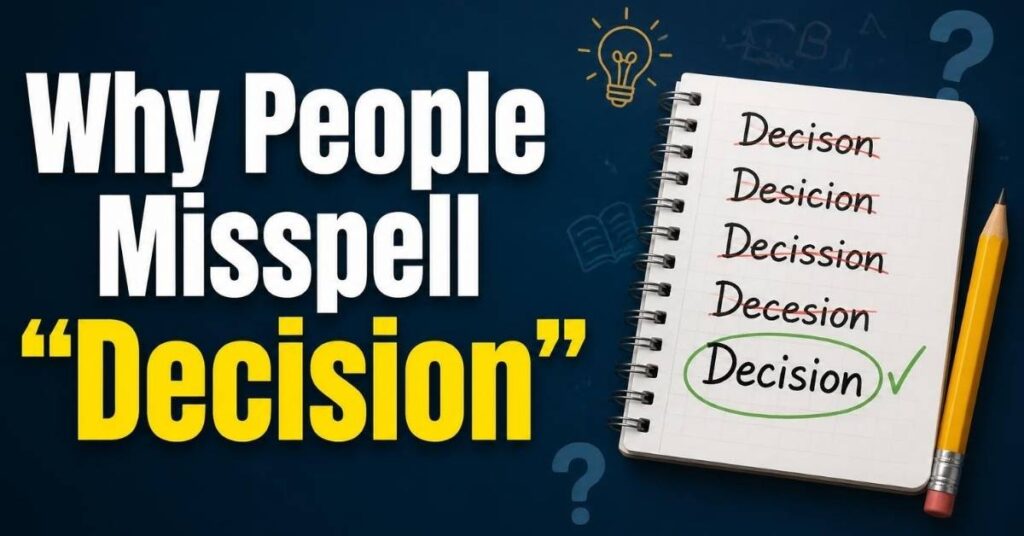
Most of us learn this word by ear before we see it in print.
That gap between sound and spelling causes almost every common writing error here.
Three habits do most of the damage.
Let’s look at each one so you can spot your own pattern.
Pronunciation Blurs the Letters
Say the word fast and it sounds like “dih-SIZH-un.”
The soft zh sound hides the letters behind it.
Your brain fills that gap with an extra s.
That’s a textbook case of pronunciation confusion.
Double “S” Confusion
Words like description and discussion put an s before a c.
You’ve seen them so often that “descision” starts to look normal.
This double s confusion fools the eye.
Decision only has one s, and it comes after the c and i.
Typing Speed and Habit
Fast typing turns small slips into habits.
Once your fingers learn “descision,” they repeat it on autopilot.
Autocorrect can hide the typing error for a while.
Then you switch devices and the mistake comes back.
Real Example
Picture a project manager sending a client update at 5 p.m.
She writes “the final descision is due Friday” and hits send.
The client never mentions it.
Still, that slip quietly dents her writing accuracy in their eyes.
What Does “Decision” Mean?
A decision is a conclusion you reach after weighing your options.
It’s the moment you stop thinking and commit.
Say you’re comparing two job offers.
The decision meaning is simple: you studied both and picked one.
Simple Definition
A decision is a firm choice made after real thought.
It works as a noun, and it names both the act and the result.
The definition of decision also covers official rulings, like a court’s verdict.
The spelling stays the same in every setting.
In Plain Language
Think of it as your final answer to “What am I going to do?”
Once you say it out loud, you’ve made one.
Sometimes the answer comes quickly.
Other times it takes weeks of second guessing.
Where You Use It
You’ll use this word at home, at work, in school, and in courtrooms.
It appears in everyday writing and formal writing alike.
That range is exactly why the spelling matters.
Readers meet it in emails, reports, and essays every single day.
Common Contexts
Here’s where you’ll bump into it most often.
Each area carries its own flavor.
- Personal decisions like moving, dating, or buying a car
- Business decisions like hiring, pricing, or launching a product
- Academic decisions like picking a major or a thesis topic
- Legal decisions like court rulings and contract terms
- Healthcare decisions like choosing a treatment plan
Examples Table
| Context | Sentence |
| Personal | I made a tough decision to move closer to my parents. |
| Business | The board’s final decision came after a long meeting. |
| Academic | Her decision about the thesis topic surprised everyone. |
| Legal | The judge announced the decision at noon. |
| Healthcare | The family made a careful decision about treatment. |
Is “Descision” a Real Word?
No, it isn’t.
You won’t find descision in major dictionaries.
It’s a misspelling, plain and simple.
The fix takes about five seconds.
What It Actually Is
Think of it as a typo that many people repeat.
Nobody coined it on purpose.
It grows out of sound and habit, not from any language rule.
That’s why it counts as a spelling error, not a variant.
Where It Appears
You’ll spot it in emails, chat messages, social posts, and rushed reports.
People also search it, because Googling a spelling is a quick way to check.
Its cousins decission and desicion pop up too.
All three fail the same test.
The Spelling Rule Behind “Decision”
A clear spelling rule explains this word.
Once you see it, you won’t need to memorize anything.
The rule starts with the base word.
Everything else follows from there.
Word Formation
Decision grows from the verb decide.
Swap the final d for an s, drop the e, and add ion.
That’s word formation at work.
It also explains why the noun carries only one s.
Transformation Pattern
English repeats this transformation pattern with many verbs.
Check how the endings shift.
- decide becomes decision
- divide becomes division
- collide becomes collision
- conclude becomes conclusion
- explode becomes explosion
Spot the pattern and the spelling stops feeling random.
Each noun keeps a single s, just like decision.
Key Rule
Verbs ending in “ide” often turn into nouns ending in “ision.”
That’s your standard usage shortcut.
No extra s sits before the c.
The order is always d, e, c, i, s, i, o, n.
Visual Breakdown
Split the word into three chunks: de + ci + sion.
Look at each one on its own, then join them.
Try writing it once in big letters on paper.
Your hand remembers what your eyes skim past.
Decision vs Decide: What’s the Difference?
Decide is what you do.
Decision is what you end up with.
Mixing them up creates awkward sentences.
Let’s clear that up.
Simple Explanation
Decide is a verb, and decision is a noun.
One describes an action, and the other names the result.
Think of bake and cake.
You bake first, and then you have a cake.
Comparison Table
| Decide | Decision | |
| Part of speech | Verb | Noun |
| Meaning | To choose after thinking | The choice itself |
| Example | I’ll decide tonight. | My decision is final. |
Examples
“We need to decide by noon.”
“Our decision changed the whole plan.”
You can’t swap them.
“I made a decide” sounds wrong to any native ear.
Decision vs Choice: Key Differences
These two get mixed up all the time.
They overlap, but they aren’t twins.
A choice is often light, while a decision carries weight.
Let’s break down why.
Core Difference
A choice means picking from the options in front of you.
A decision usually follows real thought and leads to commitment.
You choose a coffee flavor.
You decide to change careers.
Comparison Table
| Choice | Decision | |
| Weight | Often light | Usually heavy |
| Effort | Quick | Involves evaluating options |
| Result | A selection | A final outcome |
| Example | Her choice was tea. | Her decision was to resign. |
Example
Choosing lunch takes ten seconds.
Deciding whether to take a job in another city takes weeks.
That gap tells you which word fits.
If it keeps you up at night, call it a decision.
Decision vs Decision-Making
They look alike, but they aren’t the same thing.
One is a moment, and the other is a journey.
Mixing them up muddies your writing.
Here’s the clean split.
Decision
A decision is the point where you commit.
It’s the answer, not the thinking behind it.
Most of the time, it fits in one short sentence.
“We’re hiring Maya” is a decision.
Decision-Making
Decision-making is the decision-making process itself.
You gather facts, consider options, weigh risks, and then pick one.
It often stretches across meetings, emails, and long walks.
The result comes later.
Example
“Her decision was to hire Maya.”
“The decision-making took three weeks.”
Same topic, different focus.
The first names the result, and the second names the effort.
Quick Comparison
Use this as a fast reminder.
Each line shows what the word points to.
- Decision: the result, usually one sentence long
- Decision-making: the steps that lead there, often a long stretch of work
Correct Collocations: Make, Take, or Do a Decision?
Verbs and nouns pair up in fixed ways.
Pick the wrong verb and readers notice.
Here’s what works and what doesn’t.
UK and US habits differ a bit, so keep your audience in mind.
Correct Usage
Make a decision works everywhere.
Reach a decision fits formal moments, like meetings and rulings.
Take a decision is common in British English.
American writers usually prefer “make.”
Incorrect Usage
Do a decision is wrong.
It’s a frequent slip for English learners.
You’ll hear it in casual speech now and then.
Skip it in anything you publish.
Why “Make” Works
Make suggests creating something new.
A decision didn’t exist until you formed it.
Do belongs to tasks, like homework or laundry.
That’s why “do a decision” feels off.
Examples
“We must make a decision today.”
“The committee will reach a decision soon.”
“She took a decision that surprised everyone.”
That last one sounds natural in British English.
How to Use “Decision” in Sentences
This word fits into a handful of easy patterns.
Learn them once and you can use them anywhere.
The patterns below cover most situations.
Practice a few out loud.
Read More: Neice or Niece: The Spelling Mistake Everyone Makes 2026
Common Structures
Decision pairs with prepositions, adjectives, and verbs.
Each combo has a natural rhythm.
- decision + about, on, or to: a decision about pricing
- adjective + decision: a difficult decision, a final decision
- verb + decision: make, reach, or announce a decision
- noun + decision: a career decision
Examples
You can use decision in sentences like these.
Each one shows a different pattern.
- “It was a difficult decision, but it felt right.”
- “Her career decision surprised her manager.”
- “What’s your decision about the offer?”
- “They reached a final decision after two hours.”
Common Spelling Mistakes (And Why They Happen)
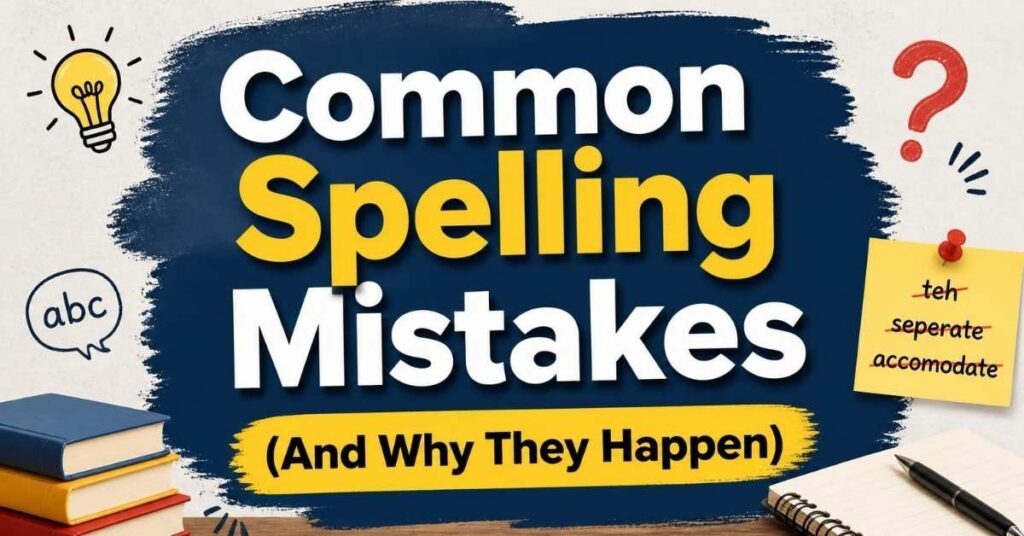
Descision isn’t the only wrong version out there.
A few cousins float around too.
Knowing why each one happens makes them easier to dodge.
It all comes down to sound guessing.
Frequent Errors
| Wrong | Correct | What went wrong |
| descision | decision | extra s before the c |
| decission | decision | doubled s near the end |
| desicion | decision | c and s swapped |
| decison | decision | missing i |
Why These Happen
The soft zh sound has no obvious letter.
So your brain guesses, and each person guesses differently.
Fast typing makes it worse.
Your fingers race ahead of your spelling memory.
Quick Fix
Say de-ci-sion slowly, one chunk at a time.
Then check it against the verb decide.
That takes five seconds.
It saves you from an awkward typo.
Pronunciation Guide for “Decision”
Say it out loud right now.
It sounds like “dih-SIZH-un.”
A good pronunciation guide supports spelling accuracy.
When you hear each part, you can write each part.
Breakdown
The word has three syllables: de, ci, sion.
The stress lands on the middle one.
The “sion” ending sounds like “zhun.”
That’s why so many writers stumble here.
Why It Helps
Slowing down links the sound to the letters.
That connection matters most for language learning.
Try saying it three times while writing it.
You’ll feel the pattern lock in.
Real-World Usage of “Decision”
This word shows up everywhere.
Let’s see how it behaves in real settings.
Each area has its own tone.
The spelling stays the same.
Everyday Life
“Should we move to a bigger place?”
“It’s a big decision, so let’s sleep on it.”
Notice how casual it sounds.
Yet the spelling still matters in a text or a note.
Business Context
In business communication, this word appears in almost every update.
“Please confirm the decision by Monday” is a typical line.
A typo here looks careless.
It can weaken your professional writing fast.
Case Study
Here’s a scenario many teams will recognize.
A startup sends a pricing proposal with “descision” in a slide header.
The investor spots it and starts checking other details.
One small error makes the whole deck feel rushed.
Academic Context
Students write this word in essays and research papers.
In statistical analysis, you’ll also see terms like “decision rules.”
Spelling it right supports your academic writing.
It shows you care about details.
Memory Tricks to Spell “Decision” Correctly
Rules are great, but tricks stick better.
Here are three that actually work.
Pick the one that clicks for you.
Then use it every time.
Think of the Root Word
Decide leads straight to decision.
The word traces back to a Latin verb meaning “to cut off.”
Picture cutting off your other options.
That image ties the spelling to the meaning.
Visual Pattern
Look at the letters in order: d, e, c, i, s, i, o, n.
The s comes after the c and i, never before.
Draw a tiny arrow from c to s.
It reminds you which comes first.
Simple Rule
Keep this line in your head: one s, after the ci.
That’s the whole trick.
Repeat it twice when you’re unsure.
It works faster than opening a dictionary.
Practice Section: Test Your Understanding
Time to try it yourself.
Cover the answers at the bottom first.
Take your time.
There’s no timer here.
Read More: Geez vs Jeez: Which Spelling Is Right? Find Out in 2026
Fill in the Blank
- We made the final ___ on Friday.
- It was a tough career ___.
- Please ___ by noon.
Multiple Choice
Which spelling is right?
- a) descision
- b) decision
- c) decission
- d) desicion
Fix the Sentence
- “The descision was hard to make.”
- “Did you do a decision yet?”
Answers: Fill in the blank: 1) decision, 2) decision, 3) decide. Multiple choice: b. Fix the sentence: 1) “The decision was hard to make.” 2) “Did you make a decision yet?”
Advanced Usage Tips
Once you’ve nailed the spelling, work on style.
Small tweaks make your writing sharper.
Good sentence flow comes from picking the right word at the right moment.
Two habits help most.
Avoid Repetition
Using “decision” five times in one paragraph gets dull.
Mix in words like resolution, conclusion, or verdict.
Keep the meaning intact when you swap.
Not every synonym fits every sentence.
Match Context
A judge issues a ruling, not a choice.
A friend picks a restaurant, not a resolution.
Match the word to the setting.
That’s how you improve writing clarity without extra effort.
Keep It Precise
Say exactly what you decided.
“The decision is final” beats “things are sorted.”
Precise wording raises readability and cuts follow up questions.
Your reader shouldn’t have to guess.
Proofreading Checklist Before You Hit Send
A quick scan saves you from embarrassing slips.
Run through this list next time.
- Read the word out loud, chunk by chunk
- Search your draft for “descision” and “decission”
- Check that you wrote “make,” not “do,” before decision
- Turn on your spell checker, but don’t trust it blindly
Small habits build writing confidence.
You’ll catch mistakes before your reader does.
Conclusion
The right spelling is decision, with one s and no extra letters tangled in the middle.
Descision is a spelling error born from sound, speed, and habit. Lean on the root word decide, the de, ci, sion chunks, and the “one s” rule.
Those three tools keep your writing skills sharp. Which spelling trick worked best for you?
Drop it in the comments, and share this guide with someone who types fast.
FAQs
Q1: Why is “Decision” correct but “Descision” wrong?
Decision comes from the verb decide, and the noun keeps a single s.
Descision adds an extra s that the root word never had.
Q2: Why do people often type Descision instead of Decision?
The soft “zh” sound has no obvious letter.
So people guess, and fast typing locks the guess into habit.
Q3: Does this spelling mistake affect communication?
Most readers still understand you.
But it can hurt communication quality and make your work look rushed.
Q4: How can I avoid this mistake?
Chunk the word as de, ci, sion, and link it to decide.
A quick read aloud before sending also helps.
Q5: Where is the word Decision commonly used?
You’ll find it in daily talk, workplaces, schools, courts, and hospitals.
It’s part of everyday writing and professional communication alike.

Oliver Matthew Wilson is a passionate grammar writer who shares simple English lessons, vocabulary tips, writing advice, and clear guides to help readers communicate confidently.