

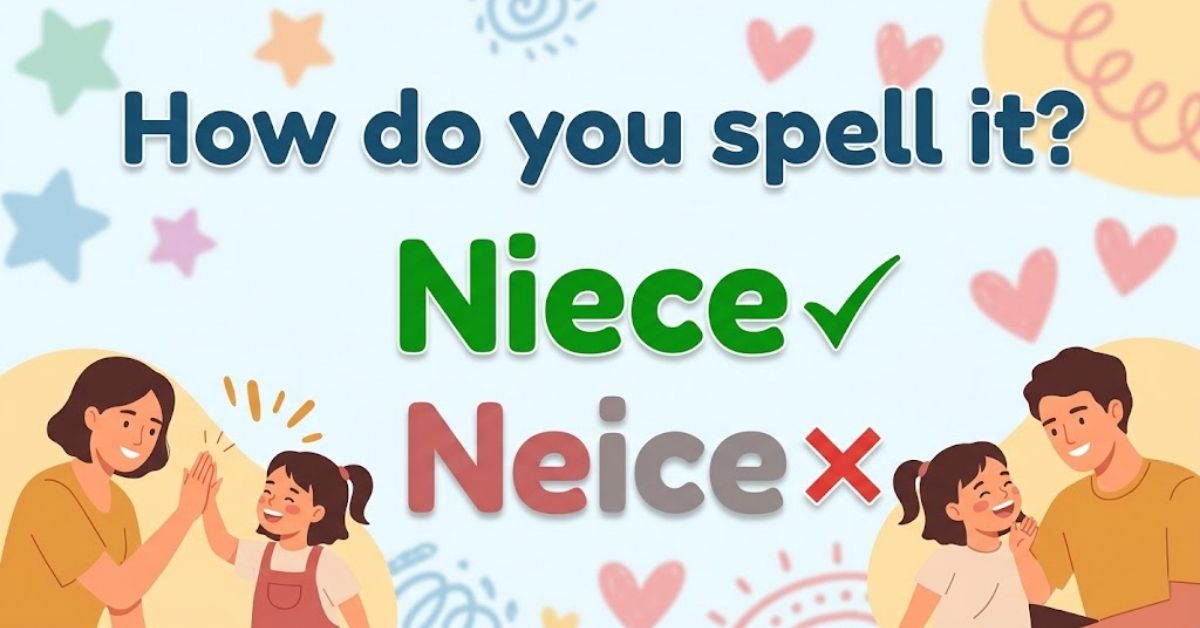
Niece is the correct spelling. “Neice” is a common misspelling that happens because of how the word sounds when spoken. If you’ve ever paused mid-sentence wondering which one to type, you’re not alone.Thousands of people search this exact question every month.
This guide breaks down the correct spelling, the meaning, the history, and the tricks that make it stick for good.You’ll also see how British and American English treat the word, where people go wrong, and how to avoid the mix-up in emails, texts, and everyday writing. By the end, spelling niece correctly will feel automatic.
Neice or Niece – Quick Answer
The correct spelling is niece.
“Neice” is never correct in standard English, no matter which country you’re writing from.
Dictionaries in both the US and the UK list only one accepted spelling.
The confusion happens because English has a habit of breaking its own rules.
People hear the word, guess at the letters, and land on the wrong order.
That single guess is where most spelling mistakes start.
Read More: Geez vs Jeez: Which Spelling Is Right? Find Out in 2026
Simple Rule to Remember
Think of the phrase “my niece is nice.”
Both words share the same IE pattern.
That little rhyme locks the spelling in place better than any grammar rule.
What Does “Niece” Mean?
A niece is the daughter of your sibling.
That includes your brother’s daughter or your sister’s daughter.
It’s one half of a pair, with “nephew” covering the son.
The word describes a specific family relationship, not a general term for a young relative.
Cousins, grandchildren, and stepchildren all have their own separate labels.
Getting this right matters in legal documents, family trees, and everyday conversation.
Examples of Niece in Sentences
My niece just started college this fall.
She’s my sister’s daughter, so technically she’s my niece.
We’re taking our niece and nephew to the zoo this weekend.
His niece flew in from Chicago for the holidays.
Why People Confuse Neice and Niece
English spelling doesn’t always follow logic, and “niece” is a good example.
The confusion isn’t about intelligence or carelessness.
It comes from real patterns in how people read, hear, and type.
Most of the reasons below apply to dozens of other English words too.
Once you understand why the mistake happens, it’s easier to catch yourself before hitting send.
The “I Before E” Rule Causes Trouble
Most people learn “I before E, except after C” in school.
That rule works for words like “believe” and “receive.”
It doesn’t explain everything, though, since English has so many exceptions.
Pronunciation Sounds Identical
Say “neice” and “niece” out loud.
They sound exactly the same.
This kind of identical pronunciation is exactly why spell check exists.
Fast Typing Leads to Errors
When you’re typing quickly, your fingers sometimes move faster than your brain checks the order.
Letter swaps like this are common typing habits, not a sign you don’t know the word.
Autocorrect Makes People Forget
Autocorrect quietly fixes “neice” to “niece” so often that some people never actually learn the correct order themselves.
It’s convenient, but it can leave gaps in real spelling confidence.
The Origin of the Word Niece
Understanding where “niece” comes from helps explain why it’s spelled the way it is.
Like many English words, it traveled through several languages before landing in its current form.
Latin Origins
The word traces back to the Latin term neptis, meaning a granddaughter or niece.
Latin heavily influenced European languages, and this root eventually branched into different words across the continent.
French Influence
Old French shaped the word into “nece,” and Norman French speakers brought it into England after 1066.
A large chunk of English vocabulary, especially around family and law, came from this French influence.
Middle English Development
By the time of Middle English, the spelling shifted again and slowly settled into something close to what we use today.
This kind of gradual change is normal.
English has been evolving for over a thousand years.
Neice vs Niece Comparison Table
| Spelling | Correct? | Notes |
| Niece | Yes | Standard spelling in all English dialects |
| Neice | No | Common misspelling, not found in dictionaries |
| Neace | No | Rare misspelling, also incorrect |
| Neice’s | No | Incorrect possessive form of a misspelled word |
| Niece’s | Yes | Correct singular possessive |
British English vs American English Usage
This is one spelling that doesn’t split between British English and American English.
Unlike “color” versus “colour,” there’s no regional variation to worry about.
American English Examples
My niece lives in Texas.
Her niece works in marketing.
British English Examples
My niece lives in Manchester.
Her niece works at the local council.
Both examples use the exact same spelling, which makes “niece” one of the more consistent words in the language.
Which Spelling Should You Use?
Always use niece.
There’s no context, formal or casual, where “neice” becomes acceptable.
Use Niece In:
Emails and business communication
Legal documents and business reports
Social media posts
Academic writing
Everyday conversation
Example
“Please welcome my niece, who will be joining the team next month” works in a professional email exactly the way it works in a text to a friend.
How to Remember the Correct Spelling
A few small memory tricks can fix this mix-up for good.
The “Niece Has IE” Trick
Notice that “niece” contains the letters IE, just like “piece” and “believe.”
Grouping it with words you already spell correctly builds automatic muscle memory.
Connect It to “Piece”
“Niece” rhymes with piece, and both share the same letter order.
Next time you’re stuck, picture a piece of pie next to your niece.
Visual Memory Technique
Some people remember better through images.
Picture the word written out, with the IE highlighted in your mind.
Write It Repeatedly
Old fashioned repetition still works.
Writing the correct spelling a few times builds the kind of muscle memory that typing alone doesn’t.
Common Mistakes With Neice or Niece

Even after learning the rule, small errors can slip through.
Switching the Vowels
Writing “neice” instead of “niece” is the most common mistake, caused by a simple vowel order swap.
Incorrect Plural Forms
The plural is “nieces,” not “neices” or “niece’s.”
Keep the base spelling and just add an S.
Capitalization Problems
“Niece” is a common noun and doesn’t need a capital letter unless it starts a sentence.
Possessive Errors
The singular possessive is “niece’s,” and the plural possessive is “nieces’.”
Mixing these up is one of the more frequent grammar rules people forget.
Niece in Everyday Examples
Seeing the word used across different settings makes the correct spelling stick even faster.
In Emails
“I wanted to introduce my niece, who’s interning with us this summer.”
In Social Media Posts
“Best day ever with my niece at the beach!”
Also In News Articles
“The senator’s niece spoke at the community event on Saturday.”
In Professional Writing
“Please add my niece as an emergency contact on the account.”
And In Casual Conversation
“My niece just got her driver’s license, can you believe it?”
Why English Spelling Feels So Complicated
English pulls words from so many places that consistency was never really on the table.
English Borrowed Words From:
Latin
Old French
Greek
German
Old Norse
Examples of Weird English Spellings
Words like “weird,” “leisure,” and “foreign” break the “I before E” rule entirely.
That’s exactly why so many English learners find spelling frustrating rather than logical.
The Psychology Behind Spelling Mistakes
There’s actual science behind why words like “niece” trip people up.
The Brain Reads Shapes
Your brain often recognizes whole word shapes instead of reading letter by letter.
That makes it easier to miss a swapped vowel.
Typing Habits Matter
Repeated typing patterns build muscle memory.
If you’ve mistyped a word before, your fingers may keep repeating that same error.
Low Frequency Reduces Confidence
Words you don’t write often, like “niece,” don’t get reinforced as much as everyday words.
These low-frequency words are more likely to trip people up.
Niece in Literature and Popular Culture
The word shows up constantly across books, films, and everyday media.
Classic Literature
Classic novels frequently mention nieces within larger family plots, often tied to inheritance or family drama.
Modern Movies and TV
Modern shows and movies use “niece” regularly in family centered storylines, keeping the word part of everyday pop culture vocabulary.
Social Media Usage
Hashtags and captions featuring “niece” are common on platforms like Instagram, usually attached to family photos and milestone celebrations.
Grammar Rules Related to Niece
A quick grammar refresher helps lock in correct usage.
Singular and Plural Forms
Singular: niece.
Plural: nieces.
Possessive Forms
Singular possessive: niece’s book.
Plural possessive: nieces’ books.
Commonly Confused Family Words
“Niece” isn’t the only word that causes mix-ups.
Niece vs Nephew
A niece is a sibling’s daughter, while a nephew is a sibling’s son.
Aunt vs Ant
“Aunt” refers to a family member, while “ant” is the insect, a classic homophone slip.
Principal vs Principle
A “principal” runs a school, while a “principle” is a rule or belief, a mix up almost as common as neice versus niece.
Neice or Niece in SEO and Google Searches

This mistake isn’t just a writing issue.
It’s also a real SEO pattern.
Why Misspelled Keywords Matter
People type “neice meaning” or “neice spelling” into search engines constantly, creating real typo traffic.
Google usually recognizes the search intent and shows results for “niece” anyway.
That’s exactly why understanding common misspellings matters for both writers and website owners.
Educational Importance of Correct Spelling
Spelling accuracy carries weight beyond just looking polished.
Teachers Notice Errors Quickly
Spelling mistakes stand out fast in schoolwork, and repeated errors can affect grades and feedback.
Employers Pay Attention Too
Typos in professional emails or reports can quietly damage credibility, even when the actual message is solid.
Strong Writing Builds Trust
Clean, accurate writing signals attention to detail.
That builds writing confidence and trust with your reader.
Examples of Correct and Incorrect Usage
Correct Examples
My niece graduated last spring.
Her niece is visiting next week.
Our niece loves painting.
Incorrect Examples
My neice graduated last spring.
Her neice is visiting next week.
Our neice loves painting.
Fun Memory Tricks for Niece
A little humor makes spelling easier to remember.
The “Nice Niece” Trick
Say it out loud: “my nice niece.”
The rhyme sticks in your head far longer than a grammar rule does.
Picture Association
Imagine a niece holding a piece of pie, since both words share the same IE pattern.
Rhyme Technique
Pair “niece” with “piece” in a short rhyme, and the correct order becomes almost impossible to forget.
How Correct Spelling Improves Communication
Clear spelling isn’t just about looking smart.
It actually changes how your message lands.
Example
A reference letter that spells “niece” correctly reads as more polished than one with an obvious typo.
Small details like this shape how readers judge the whole piece of writing.
How Dictionaries Standardized Niece
Dictionaries play a big role in locking spelling into place.
Dictionary Consensus
Every major English dictionary, from Merriam Webster to Oxford, lists only “niece” as correct.
Why Standardization Matters
Without a dictionary consensus, spelling would drift wildly across regions.
That would make written communication far harder to follow.
How Children Learn the Word Niece
Kids often learn this word through family context long before they learn to spell it.
Helpful Learning Methods
Flashcards with the word and a family photo
Simple sentence practice
Short spelling quizzes
Reading books that use family vocabulary
Niece in Digital Communication
The word shows up constantly across modern messaging.
Text Messages
“Can’t wait to see my niece this weekend!”
Social Media
Captions and comments use “niece” heavily in family posts and celebration photos.
Professional Platforms
LinkedIn posts and company newsletters sometimes reference employees’ nieces in community or scholarship stories.
Quick Reference: Neice vs Niece
| Question | Answer |
| Correct spelling? | Niece |
| Used in US and UK? | Yes, identically |
| Plural form? | Nieces |
| Possessive form? | Niece’s / Nieces’ |
| Is “Neice” ever correct? | No |
Conclusion
“Niece” is the only correct spelling, in every English speaking country and every kind of writing.
“Neice” is simply a common typo, driven by identical pronunciation, fast typing, and a language full of spelling exceptions.
With a few memory tricks, like pairing it with “piece” or “nice,” the correct order becomes second nature.
The next time you write about your sibling’s daughter, you’ll spell it right without even pausing.
FAQs
Q1: What is the correct spelling, Neice or Niece?
Niece is correct.
“Neice” is a common misspelling and isn’t found in any standard dictionary.
Q2: Why do people confuse Neice and Niece?
Identical pronunciation, fast typing, and English’s inconsistent spelling rules all contribute to the mix-up.
Q3: Is Neice accepted in British English or American English?
No.
Both dialects use only “niece,” with no regional variation.
Q4: How can I remember the correct spelling of Niece?
Pair it with “piece” or “nice,” since both share the same IE letter order.
Q5: Why does correct spelling matter in communication?
It builds credibility and clarity, especially in professional emails, resumes, and formal writing, where small errors can shape how a reader judges the whole message.

Oliver Matthew Wilson is a passionate grammar writer who shares simple English lessons, vocabulary tips, writing advice, and clear guides to help readers communicate confidently.