

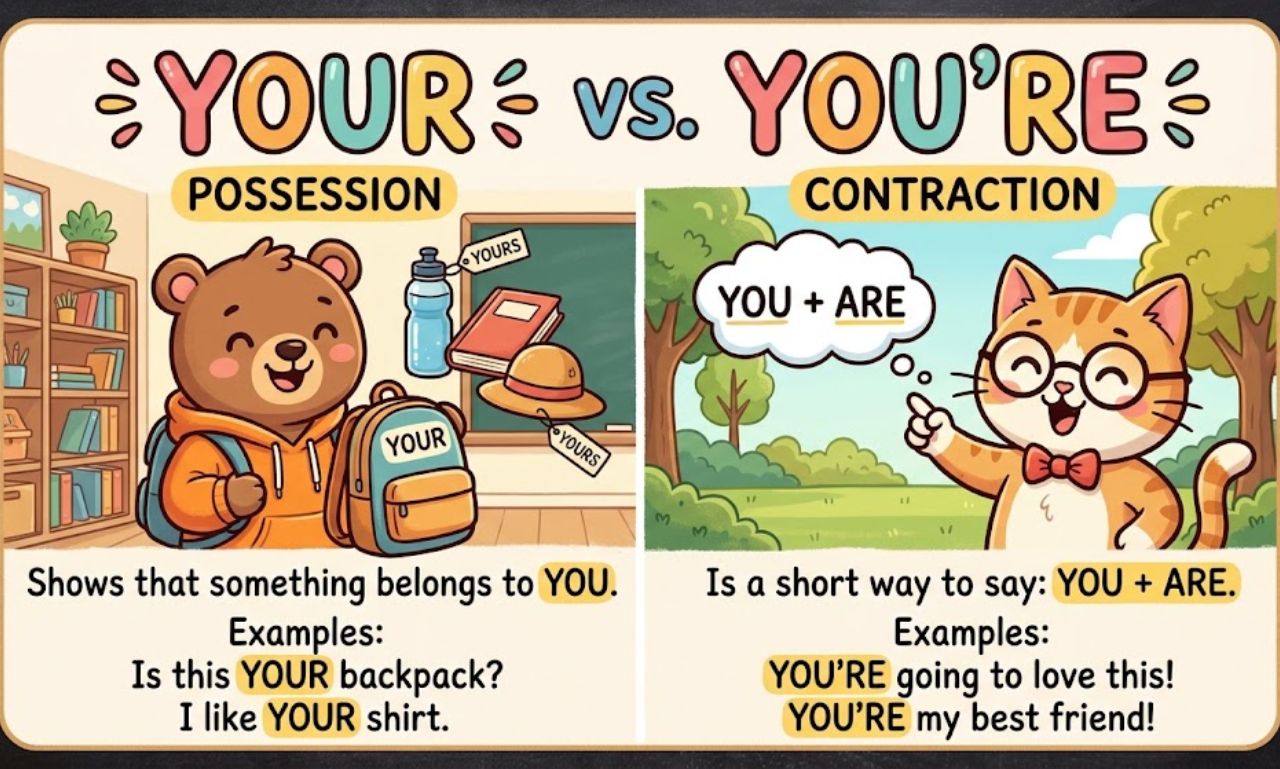
Mastering everyday grammar can feel surprisingly tricky when two words sound identical but mean completely different things. Misusing your vs you’re is one of the most common writing mistakes in online chat, social media posts, and professional emails. Understanding basic parts of speech, word usage, and sentence structure ensures your written communication remains clear, grammatically correct, and polished across every digital platform.
Ever sent a quick text or posted a casual comment only to instantly realize a glaring spelling error ruined your message? That single misplaced apostrophe or homophone swap can accidentally change your entire thought expression, confusing the reader and undermining your credibility.
Getting these language terms right boosts your writing clarity and grammar skills immediately. Consistent vocabulary practice makes correct usage second nature, keeping your daily messaging smooth, professional, and completely error-free.
What Is the Difference Between Your and You’re?
The fundamental distinction between these two terms rests entirely on their grammatical function within a sentence. While both words are pronounced identically as homophones, they perform completely different roles in English grammar. One indicates ownership, while the other serves as a shortened combination of two separate words.
The table below provides a quick breakdown of how these two terms differ in meaning, structure, and usage:
| Characteristic | Your | You’re |
| Part of Speech | Possessive Adjective / Determiner | Contraction (You + Are) |
| Grammatical Purpose | Indicates ownership or association | Expresses a state of being or ongoing action |
| Punctuation | Contains no apostrophe | Contains an apostrophe replacing the letter “a” |
| Substitution Rule | Can be swapped with my, his, or her | Can be expanded into the two-word phrase you are |
| Following Word Type | Followed by a noun or noun phrase | Followed by an adjective, verb (-ing), or preposition |
| Sample Sentence | Is this your jacket? | You’re going to be late! |
As shown in the table, your functions as a possessive modifier, whereas you’re contains an active or linking verb. A reliable way to determine which word is appropriate is to perform a simple substitution test: if you can expand the word in your sentence to you are without breaking the grammar or changing the intended meaning, then the contraction with an apostrophe is correct. If substituting you are creates an awkward or ungrammatical sentence, the possessive form is required.
- Incorrect: Is that you’re jacket sitting on the chair? (Is that you are jacket… does not make sense)
- Correct: Is that your jacket sitting on the chair?
Understanding this core structural difference prevents embarrassing miscommunications in both casual messaging and formal workplace documentation.
What Does Your Mean?
The term functions strictly as a possessive determiner or possessive adjective in the English language. It is used to modify a noun by showing that the noun belongs to the listener or reader (the second-person point of view).
Because it is an adjective, it must always be followed by a noun, a noun phrase, or a gerund (a verb acting as a noun). It can modify singular or plural nouns, concrete objects, or abstract concepts.
Here are the primary linguistic functions of the possessive form:
- Direct Ownership: Indicating physical items belonging to someone (e.g., your vehicle, your keys).
- Personal Attributes: Referring to qualities, traits, or body parts (e.g., your patience, your hair).
- Relationships: Identifying connections to other people or animals (e.g., your manager, your cat).
- Abstract Concepts: Denoting ideas, timeframes, or actions associated with someone (e.g., your scheduled appointment, your opinion).
In every instance, the word establishes a relationship of belonging between the subject and the object that follows it.
What Does You’re Mean?
The term you’re is a grammatical contraction formed by combining the second-person pronoun you with the linking or auxiliary verb are. The apostrophe acts as a visual placeholder that replaces the missing letter a in are.
Because this word contains a hidden verb, it functions as the subject and predicate of a clause. It typically precedes an adjective, a present participle (ending in -ing for continuous tenses), or a noun phrase that describes what the subject is or what the subject is doing.
Consider the following functional breakdown:
- Before an Adjective: Describing a state of being (e.g., You’re welcome, You’re early).
- Before a Continuous Verb: Indicating active movement or ongoing action (e.g., You’re running late, You’re doing great).
- Before a Noun Phrase: Stating an identity or role (e.g., You’re a brilliant editor).
Whenever you write this word, you are expressing a complete action or state of being involving the person you are addressing.
Your vs. You’re: Simple Examples
Seeing both forms side by side in basic sentences highlights how their roles differ. The following examples demonstrate correct usage in everyday language scenarios.
Possessive Examples (Your)
- Please make sure your headlights are turned off before leaving the vehicle.
- I really appreciate your willingness to help with the community project.
- Did you remember to bring your laptop charger to the conference?
Contraction Examples (You’re)
- Let me know as soon as you’re ready to depart for the airport.
- You’re going to love the new menu items at the local bistro.
- If you’re feeling unwell, you should stay home and rest today.
Combined Examples
- You’re going to need your umbrella because it is pouring rain outside.
- Make sure you’re wearing your safety goggles in the laboratory.
- If you’re comfortable with the terms, please sign your name on the bottom line.
In the combined examples, notice how the contraction sets up an action or state of being, while the possessive form points directly to an item owned by the individual.
When Should You Use Your?
You should use the possessive form exclusively when you are describing something that belongs to, is associated with, or is attached to the person you are speaking or writing to.
To verify whether this form is required, check the words immediately following it. If the word following is a noun (such as phone, ideas, house, or dog), or an adjective directly modifying a noun (such as red car or brilliant strategy), you almost certainly need the possessive form.
Here is a simple reference table showing common nouns paired with the possessive form:
| Category | Modifier + Noun Phrase | Contextual Sentence |
| Physical Belongings | your phone | Did you leave your phone on the desk? |
| Time & Schedule | your calendar | Please check your calendar for availability. |
| Personal Identity | your signature | We require your signature on the contract. |
| Professional Role | your team | How is your team handling the new project? |
The data in the table illustrates that whenever the target word directly modifies a noun or noun phrase to show ownership or association, the possessive form without an apostrophe is mandatory.
When Should You Use You’re?
You must use the contracted form whenever your sentence requires both the subject pronoun you and the present-tense verb are.
This structure is necessary when describing an active process, an ongoing state, an identity, or a continuous condition. It is frequently followed by adjectives, adverbs, prepositional phrases, or verbs ending in -ing.
Here are common continuous tense and descriptive phrases that require the contraction:
- Active Actions: You’re driving, You’re learning, You’re working.
- States of Being: You’re exhausted, You’re correct, You’re mistaken.
- Location & Timing: You’re on time, You’re at the office, You’re next in line.
If the phrase describes an action being performed by the person or a state they are currently experiencing, the contraction featuring the apostrophe is the correct choice.
How to Remember Your vs. You’re Easily
Memorable mental tricks can eliminate hesitation when writing under tight deadlines. Here are three reliable rules of thumb to guarantee accurate word selection every time.
The Expansion Test
The single most effective method is the Expansion Test. Every time you write the word, pause and read the sentence aloud, replacing the word with you are.
- Test Sentence: Is this [your / you’re] coat?
- Try expanding: Is this you are coat? -> Fails. Use your.
- Test Sentence: [Your / You’re] invited to the celebration.
- Try expanding: You are invited to the celebration. -> Passes. Use you’re.
The “It Belongs to Me” Swap
If you are unsure about the possessive form, try replacing the word with another possessive pronoun, such as my or his. If the sentence structure remains intact, your original choice was correct.
- Test: I like your shoes. -> I like my shoes. (Makes sense grammatically; your is correct.)
The Apostrophe Visual Cue
Remember that the apostrophe in the contraction acts as a tiny letter A. If you need the verb are in your sentence, you need the apostrophe to hold its place. No verb needed? No apostrophe needed.
Your vs. You’re in a Sentence
Placing both words in complex or compound sentences reveals how they interact within standard English syntax. Mastering their placement within a single sentence ensures your writing flows smoothly without confusing readers.
Consider these multi-clause examples:
- When you’re finished with your assignment, please submit it through the online portal.
- If you’re not careful, your coffee will spill all over the keyboard.
- You’re going to damage your reputation if you’re constantly late to your client meetings.
In the first example, you’re introduces the clause describing the person’s status (when you are finished), while your modifies the noun assignment to show ownership. In the third example, alternating between state-of-being clauses and possessive noun phrases demonstrates how both forms maintain distinct grammatical roles within a single thought.
Common Mistakes With Your and You’re
Even experienced writers can make casual mistakes when typing quickly or relying solely on automated spell-check tools. Spellcheckers often miss these homophone errors because both entries are valid English words.
Here are the most common error patterns and why they occur:
1. Misplacing the Apostrophe in Formal Greetings
- Incorrect: Thank you for you’re time and consideration.
- Correct: Thank you for your time and consideration.
- Explanation: “Time” is a noun owned by the recipient. Substituting “you are time” is grammatically incorrect.
2. Using Possessives Before Continuous Verbs
- Incorrect: I hope your coming to the party tonight.
- Correct: I hope you’re coming to the party tonight.
- Explanation: “Coming” is a present participle requiring the auxiliary verb “are” to form the continuous tense (you are coming).
3. Autocorrect Over-Correction on Mobile Devices
Mobile keyboards frequently default to contractions when inserting punctuation. Writers often accept suggested text without verifying if a possessive modifier was required instead.
Your vs. You’re in Everyday English
In casual dialogue, informal texting, and digital communication, these words are used constantly. However, informal contexts often breed sloppy habits that spill over into professional writing.
In digital environments like messaging apps and social platforms, readers make split-second judgments about authority and professionalism based on mechanical accuracy.
Professional Email Etiquette
Using the incorrect homophone in a job application, client proposal, or executive update can undermine your professional credibility.
- Unprofessional: We received you’re resume and your hired!
- Professional: We received your resume and you’re hired!
Social Media & Content Creation
Clear grammar improves readability on public platforms. Posts containing basic errors attract negative corrections in comment sections, shifting audience attention away from your core message.
Maintaining consistent accuracy across casual text messages and formal documentation builds strong communication habits that prevent awkward slips in high-stakes environments.
Your vs. You’re vs. Yours
Another word that frequently enters this grammatical mix is yours. Understanding how yours differs from the other two terms prevents further confusion.
While your is a possessive adjective that must precede a noun, yours is an absolute (or independent) possessive pronoun. This means yours stands entirely by itself and replaces the noun altogether rather than modifying it. Crucially, yours never takes an apostrophe.
The following list compares how these three distinct terms operate:
- Your (Possessive Adjective): Requires a noun immediately after it. (e.g., That is your pen.)
- Yours (Possessive Pronoun): Replaces the noun entirely; stands alone. (e.g., That pen is yours.)
- You’re (Contraction): Replaces the words you are. (e.g., You’re holding the pen.)
Notice that you would never write your’s with an apostrophe. Possessive pronouns in English (such as yours, his, hers, its, and ours) inherently express ownership and do not use apostrophes.
Your vs. You’re vs. You Are
When deciding whether to use the contraction or write out you are in full, the choice depends primarily on tone, formality, and emphasis.
Both options are grammatically identical in meaning, but they serve different stylistic purposes in written English:
- You Are (Uncontracted Form): Best suited for academic papers, formal legal documents, business contracts, or when adding strong emphasis to a statement (e.g., You are strictly prohibited from entering this area).
- You’re (Contracted Form): Ideal for conversational writing, casual correspondence, blog posts, marketing copy, and everyday speech where a natural tone is preferred.
Your or You’re: How to Choose the Right Word
When editing your work, follow a simple decision tree to determine the correct spelling.
[ Need to select word ]
│
Is it modifying a following noun?
(e.g., showing ownership)
│
┌──────────────┴──────────────┐
YES NO
│ │
Use “YOUR” Can you substitute
(No Apostrophe) “YOU ARE”?
│
┌──────────────┴──────────────┐
YES NO
│ │
Use “YOU’RE” Re-evaluate
(With Apostrophe) sentence structure
Step-by-step decision framework:
- Identify the target word in your sentence.
- Look at the surrounding words. Is there a noun directly following that receives ownership? If yes, choose your.
- Attempt the substitution. Swap the target word with you are. Does the sentence still make complete sense? If yes, choose you’re.
- Read the sentence aloud. If the expanded phrasing sounds awkward or incorrect, eliminate the apostrophe and use the possessive form.
Applying this simple step-by-step audit during your final proofreading pass eliminates word choice errors.
Practice Your vs. You’re With Examples
Test your understanding by reviewing the practice sentences below. Try filling in the blanks before checking the answer key provided beneath the table.
| Sentence Number | Practice Sentence | Correct Choice |
| Sentence 1 | Please let me know when ___ flight lands. | your |
| Sentence 2 | I think ___ going to excel in this new role. | you’re |
| Sentence 3 | Don’t forget ___ jacket, as ___ bound to get cold later. | your / you’re |
| Sentence 4 | If ___ car breaks down, call for assistance. | your |
| Sentence 5 | ___ welcome to borrow my books anytime. | you’re |
Explanations for Practice Sentences
- Sentence 1 (your): Modifies the noun flight. (You would not say “when you are flight lands.”)
- Sentence 2 (you’re): Expands to “I think you are going to excel.”
- Sentence 3 (your / you’re): The first blank modifies the noun jacket (your). The second expands to “you are bound” (you’re).
- Sentence 4 (your): Modifies the noun car to show ownership.
- Sentence 5 (you’re): Expands to the standard polite phrase “You are welcome.”
Regular practice reinforces these mechanics until choosing the correct spelling becomes second nature.
Your vs. You’re: Quick Comparison
For immediate reference, this comparison matrix summarizes the core differences, functions, rules, and examples for both terms.
| Feature / Aspect | Your | You’re |
| Grammatical Part of Speech | Possessive Adjective / Determiner | Contraction (You + Are) |
| Core Function | Shows ownership or belonging | Connects subject pronoun to a verb/state |
| Includes an Apostrophe? | No | Yes |
| Key Test | Can be replaced with my, his, or her | Can be expanded to you are |
| Followed By… | Nouns or noun phrases | Adjectives, continuous verbs (-ing), or prepositions |
| Example 1 | Where is your backpack? | You’re early today! |
| Example 2 | I read your recent article. | I hope you’re feeling better. |
| Example 3 | Protect your personal data online. | Make sure you’re signed in. |
By keeping these core principles in mind and running the quick substitution test during proofreading, you can consistently eliminate confusion surrounding these words and ensure your writing remains clear, authoritative, and grammatically accurate across all mediums.
Frequently Asked Questions
Q1: How can I easily tell the difference between your vs you’re?
Try expanding the word to “you are”; if it works, use the apostrophe form, but if showing ownership, use the possessive word.
Q2: Which form of your vs you’re should I use before a noun?
Always choose the possessive form without an apostrophe when placing the word directly before a noun to indicate belonging or ownership clearly.
Q3: Is using your vs you’re incorrectly considered a major grammatical mistake?
Yes, confusing these homophones in professional emails or public writing weakens credibility and alters sentence meaning, so accurate usage is essential.
Q4: Can automated spellcheckers fix your vs you’re errors automatically every time?
No, spellcheckers often overlook these homophone mix-ups because both options are spelled correctly, making manual proofreading necessary for complete accuracy.
Q5: Which option between your vs you’re is correct in “___ welcome”?
The correct choice is the contracted form with an apostrophe because the phrase expands fully to “you are welcome” in everyday dialogue.

Oliver Matthew Wilson is a passionate grammar writer who shares simple English lessons, vocabulary tips, writing advice, and clear guides to help readers communicate confidently.