

Useable or Usable trips up a lot of writers. Both words look almost the same. Both sound the same too. But only one is correct in modern English. That word is usable. It’s the spelling you’ll find in dictionaries. It’s the one style guides recommend. And it’s the one used in emails, reports, and everyday writing.
Useable isn’t technically wrong. It’s just old and rarely used today. Most people don’t type it anymore. So if you’re ever unsure which one to pick, go with usable. It’s simple, clean, and correct. This guide breaks it all down for you. You’ll learn where the confusion started. You’ll see the grammar rule behind it. And you’ll walk away knowing exactly which spelling to use, every single time you write.
Useable or Usable: Quick Answer
Usable wins, hands down.
It’s the preferred spelling across American English, British English, journalism, and technology writing.
Useable still shows up here and there, mostly in older texts or casual writing, but it’s not the modern standard.
So if you’re ever stuck mid-sentence wondering which one to type, go with usable and move on with your day.
What Does “Usable” Mean?
Usable describes something you can actually use, something that works or serves its purpose.
It’s a simple, everyday word that shows up in tech, business, and casual conversation alike.
Simple definition:
Usable means capable of being used, practical, or fit for a purpose.
Think of it as the opposite of broken or functionally dead.
Everyday examples:
“This app has a really usable interface” means the app is easy to navigate.
“The old chair is still usable” means it still does its job, even if it’s a bit worn.
“We need usable data before we can build the report” means the numbers have to be clean, not a jumbled mess.
Is “Useable” Also Correct?
Technically, yes, useable is a recognized variant spelling.
Most major dictionaries list it, but they tag it as secondary or less common.
You won’t get flagged for using it, but you won’t look particularly polished either, especially in professional writing.
Think of useable as the spelling equivalent of socks with sandals: allowed, not exactly recommended.
Read More: Hallow vs Hollow: Which One Are You Getting Wrong? 2026
The Origin of Useable vs Usable
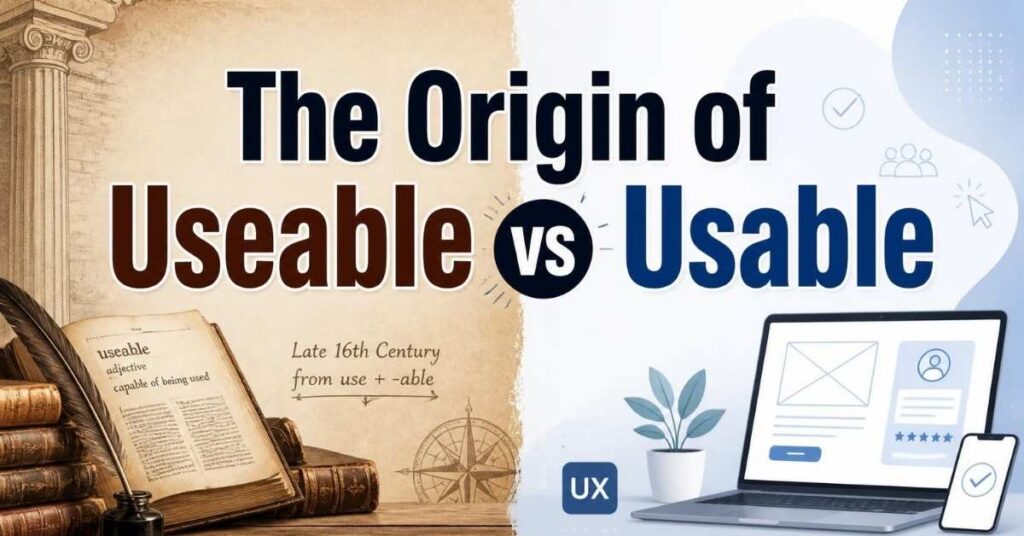
The confusion between these two spellings goes back centuries, tied to how English grammar handles suffixes and silent letters.
Understanding the root word clears up most of the mystery fast.
Root word:
Both words come from “use,” combined with the -able suffix.
Add them together and you get use + able, which should logically become useable, right?
Except English has a habit of dropping the silent e before a vowel suffix, and that’s exactly what happened here.
Why the “e” existed historically:
Older spelling kept the e to preserve the soft “s” sound in use.
Writers worried readers might pronounce it wrong without that extra letter.
Over time, as spelling patterns modernized, that worry faded and the e got dropped for good.
Grammar Rule Behind Usable
English has a general rule: when a root word ends in a silent e and you add a suffix starting with a vowel, you usually drop the final e.
Examples:
Move becomes movable.
Like becomes likable.
Use becomes usable, following the exact same word formation pattern.
Why useable still exists:
Some words break this rule when dropping the e would confuse pronunciation, like “noticeable” or “changeable.”
Useable may have survived because writers assumed it followed that same exception.
Turns out it doesn’t need one, since usable reads perfectly clear without the extra letter.
Usable vs Useable: Key Differences
| Aspect | Usable | Useable |
| Spelling standard | Preferred, modern standard | Older, less common variant |
| Dictionary status | Primary entry | Secondary or alternate entry |
| Style guide support | Widely recommended | Rarely recommended |
| Common in | Tech, business, journalism, academic writing | Older texts, casual writing |
| Search volume | Much higher | Much lower |
Dictionary and Style Guide Preferences
Dictionaries and editorial style guides are the real referees here, and they’ve mostly made their call.
Modern dictionaries:
Merriam-Webster, Oxford, and Cambridge all list usable as the primary spelling.
Useable appears as a secondary entry, which tells you exactly where usage is heading.
Editorial style guides:
The AP Stylebook and Chicago Manual of Style both favor usable in professional writing standards.
Editors trained on these guides will almost always correct useable to usable during editing.
Why this matters:
If you’re writing for publication, academic writing, or business writing, following style guide preference keeps your work consistent and polished.
Readers won’t consciously notice good spelling, but they’ll notice inconsistency, and that quietly chips away at trust.
Usable vs Useable in American and British English
Regional spelling differences explain part of the confusion, though not as much as people assume.
American English:
American English writing almost exclusively uses usable.
You’ll rarely spot useable in US publications or software documentation.
British English:
British English historically tolerated useable more than American English did.
Even so, modern British style guides and major UK publications have shifted heavily toward usable too.
Real-world observation:
Search British newspapers or tech blogs today and usable shows up far more often than useable.
The gap between British vs American spelling preferences has basically closed on this word.
Why “Usable” Became the Standard
A few practical forces pushed usable into the lead position, and none of them are random.
Simplicity wins:
Shorter, cleaner spellings tend to survive in fast-moving written English, especially online.
Usable is one letter shorter and just as clear, so it had a natural edge.
Digital reading habits:
People skim more than they read word by word now, especially on phones.
Cleaner spelling patterns are easier to process at a glance, and that matters when attention spans are short.
Technology influence:
Software documentation, UX writing, and product content moved fast toward standardization.
Once major tech companies settled on usable, everyone writing about those products followed suit.
Industry adoption:
Journalism, academic writing, and business writing all leaned toward usable as their style guides updated.
Once enough industries agreed, useable became the outlier rather than the default.
Read More: Neice or Niece: The Spelling Mistake Everyone Makes 2026
Usable in UX and Technology
Nowhere is this spelling battle more settled than in UX design and tech circles.
What “usable design” means:
A usable design lets people finish a task without confusion or wasted clicks.
It’s less about looking pretty and more about functioning the way real users expect.
Usability vs usability testing:
Usability is the overall quality of being easy and efficient to use.
Usability testing is the process teams run to check whether real users can complete tasks without getting stuck.
Why tech prefers usable:
Software engineering, product development, and interface design communities standardized on usable decades ago.
Every major UX research paper and usability framework you’ll find uses this spelling exclusively.
SEO and Search Behavior: Useable or Usable
If you’re writing for the web, search data settles this debate fast.
What data patterns show:
Search volume for usable massively outpaces useable across nearly every English-speaking region.
People type what feels natural, and usable is simply what most people’s fingers reach for.
Why this matters for content creators:
Matching the spelling readers actually search for improves keyword alignment and content visibility.
Using useable throughout an article risks looking outdated to both readers and search engines evaluating content quality.
Common Mistakes with Useable or Usable
A few recurring slip-ups keep this confusion alive, even among experienced writers.
Mistake 1: assuming both are equal in modern usage
They’re not interchangeable in professional communication, even though both are technically valid.
Treating them as equal ignores decades of dictionary preference.
Mistake 2: mixing both spellings
Some writers use usable in one paragraph and useable in the next without noticing.
This spelling consistency issue looks sloppy and undermines readability instantly.
Mistake 3: using “useable” in tech writing
Tech, software documentation, and UX writing have zero tolerance for useable.
It immediately signals unfamiliarity with industry norms.
Mistake 4: overthinking grammar rules
Some writers try to reverse-engineer the silent e rule mid-sentence and second-guess themselves.
Just remember usable is the safe, standard choice, and skip the mental gymnastics.
Examples of Usable in Real Sentences
Technology:
“The new dashboard is far more usable than the last version.”
“Developers tested whether the app remained usable on smaller screens.”
Business:
“We need usable insights from this data, not just raw numbers.”
“The proposal wasn’t usable until we fixed the formatting issues.”
Everyday life:
“Is this old bike still usable, or should we donate it?”
“The instructions weren’t very usable without diagrams.”
Examples of Useable in Sentences
“The old furniture is still useable, even after all these years.”
“Some grammar guides list useable as an acceptable variant spelling.”
“He wondered whether the paper’s structure was useable for his thesis.”
These examples show the variant still functions grammatically, even if it reads slightly dated to modern eyes.
Case Study: Why Companies Standardized “Usable”
Tech companies didn’t pick usable by accident, they picked it because consistency affects real products.
Impact on real products:
Internal style guides at major software companies mandate usable across product development and marketing copy.
This consistency reduces friction during editing, translation, and accessibility work across global teams.
When millions of users read product documentation, even tiny spelling inconsistencies add up at scale.
Read More: Geez vs Jeez: Which Spelling Is Right? Find Out in 2026
Why “Useable or Usable” Still Confuses People
1. Historical variation:
Older texts and some British sources normalized useable for generations, and that legacy lingers in memory.
2. Visual similarity:
The two words look nearly identical at a glance, which trips up even careful writers during quick proofreading.
3. Grammar assumptions:
People assume the -able suffix always keeps the root word intact, forgetting the drop-the-e pattern applies here too.
Related Words and Variations
Usability:
The noun form, describing how easy or efficient something is to use in real conditions.
User-friendly:
A related term focused specifically on ease of use for the person interacting with a product.
Functional:
A broader word meaning something works as intended, even if it isn’t necessarily user-friendly.
Which Spelling Should You Use in 2026?
Usable remains the clear, confident choice heading into 2026 and beyond.
Why this matters:
Professional writing standards, dictionary preference, and search behavior all point the same direction.
Using usable keeps your writing aligned with modern usage and readability expectations across emails, reports, and digital writing.
Quick Comparison Summary
| Category | Winner |
| Dictionary preference | Usable |
| Style guide preference | Usable |
| Tech and UX writing | Usable |
| American English | Usable |
| British English | Usable (modern) |
| Historical texts | Useable (occasionally) |
Conclusion
So, useable or usable? The answer is simple. Usable is the correct spelling, and it’s the one dictionaries prefer, style guides recommend, and most writers actually use. Useable isn’t wrong, but it feels old-fashioned now, and hardly anyone uses it anymore. When people search “useable or usable,” they usually just want a clear answer, and usable is that answer.
Next time you’re stuck between useable or usable, don’t overthink it. Just go with usable. It’s shorter, cleaner, and it’s what modern English prefers. Whether you’re writing an email, a report, or a blog post, usable is always the safe choice. So skip the useable or usable confusion for good, and stick with usable every time you write.
FAQs
Q1: What is the correct spelling: useable or usable?
Usable is correct and preferred in modern English writing.
Q2: Is “useable” wrong in English?
No, it’s a recognized variant spelling, just less common and rarely recommended today.
Q3: Why do people get confused between useable and usable?
Historical spelling variation, visual similarity, and assumptions about the -able suffix all contribute to the mix-up.
Q4: Which spelling should I use in emails and reports?
Always use usable for professional communication, academic writing, and business writing.
Q5: How can I remember the correct form?
Just remember use drops the silent e before able, the same pattern as movable and likable.

Oliver Matthew Wilson is a passionate grammar writer who shares simple English lessons, vocabulary tips, writing advice, and clear guides to help readers communicate confidently.